Growing up in the Netherlands in the 1990s, I always felt something was missing. There was no framework to understand or experience beauty meaning or a deeper transcendent reality, no connection really to anything sacred. Secularism had taken over, and while it brought certain freedoms, it also left a cultural void. Materialism basically dominated, reducing life to what could be measured or owned, leaving little room for reverence or awe. Even Christianity, in the form I encountered in my youth, often felt hollow—stripped of mystery, ritual, and beauty. And yet, this wasn’t just my personal experience. It reflects something much larger: a spiritual crisis in the West.
At times, I caught glimpses of something deeper. I remember my grandparents. They were of a generation that still carried a sense of dignity, even in simple things. The way they cared for their home, the atmosphere they created, it was subtle but palpable. There was a respect for life, a quiet humility, and a sense of meaning that was woven into the everyday.
Before meals, they would pause to say a prayer “Our Father, who art in heaven…” their voices steady, their words spoken with sincerity. Sundays were treated as a special day, marked by stillness and simplicity. Life seemed to slow down in their home as if the day itself was set apart for something sacred. These small rituals reflected a connection to something larger, something that gave their lives a quiet depth and order. It was a reminder of older values, of something we’ve largely lost in the modern West.
The Spiritual Desert of the West
Today, the West has become a spiritual desert. Materialism has flattened our view of the world, reducing human beings to biological machines and dismissing anything that cannot be quantified. Beauty, dignity, and the sacred have been pushed to the margins. As Ian McGilchrist writes in The Master and His Emissary: “We have created a world that is paradoxically everywhere and nowhere, increasingly virtual, and increasingly lacking in depth and meaning.” This lack of depth manifests in every area of life, leaving people disconnected from themselves, from each other, and from the world.
This crisis didn’t arise in isolation. Materialism is not some separate force that swept in and replaced religion it’s the result of the West’s own historical and cultural development. Protestantism, for all its virtues, rejected mystery and beauty in favor of rationality and utility. Over time, this mindset paved the way for modern capitalism and the materialistic worldview we see today. Tom Holland captures this well in his book Dominion, tracing how Christianity shaped the West’s values, but also how these values evolved into something disconnected from the sacred. We’ve lost our way, not by abandoning our roots, but by distorting them.
Our modern-day practice of spirituality hasn’t escaped this distortion. Western Buddhism, for instance, is often reduced to merely a tool for self-improvement, or through frameworks shaped by materialism or even Christian moralism. These are not words of reproach, but reflections born of my own experience with these difficulties. Through the years, I’ve come to understand, often through my own missteps that its vital to fully embrace a transcendent sacred worldview.
Buddhism is not a self-help tool, a utility, or a hobby. It’s about a radical shift in perspective, a letting go of dualistic thinking, and stepping into something far greater than ourselves.
Western Buddhists and the Struggle to Go Beyond
One of the most difficult things about being a Buddhist in the West is recognizing the water we swim in. Materialism and Christian frameworks are so deeply embedded in Western culture that we often don’t even see them. I’ve experienced this in myself, and I’ve seen it in others. Even as I embraced Buddhism, I found myself holding onto materialistic ways of thinking, viewing practice as something utilitarian, something to “fix” or improve myself. I also unconsciously carried Christian-influenced ideas of morality, seeing things in terms of right and wrong, or good and bad, rather than the more subtle and nuanced view Buddhism offers.
I’ve noticed this even more strongly in the generation that came before me, particularly among baby boomers. Many of them rebelled strongly against Christianity, rejecting its traditions and dogmas. But in doing so, they often failed to see how deeply shaped they still were by the Christian worldview. It’s as if they wanted to start fresh but couldn’t recognize the water they were still swimming in. The same is true of materialism, which permeates so much of the Western mind. Even long-term practitioners (myself included, admittedly) often unconsciously approach Buddhism through these lenses, unable to go beyond.
These influences are subtle and pervasive, and it takes tremendous effort to go beyond them. Buddhism offers us a path to transcend both nihilism (the materialist view that nothing has meaning) and eternalism (the Christian-like belief in a fixed, ultimate reality). But stepping into this path requires us to question everything we’ve been conditioned to think and believe. It requires courage, not just to reject old frameworks, but to let go of them entirely.
Dignity and the Sacred
For me, at the heart of this transformation is a rediscovery of dignity. And by dignity, I don’t mean the superficial kind tied to status or comfort. I mean the dignity that comes from recognizing our own basic goodness, what Trungpa Rinpoche called the intrinsic worth we all possess simply by existing. This understanding of dignity contrasts sharply with the modern Western worldview, where worth is measured by what you produce or own. It’s even there in the term net-worth.
I’ve been privileged to meet Buddhist masters who embody this innate dignity completely. Some of them had almost no possessions or social standing, yet their presence is awe-inspiring. The way they move, the way they wear their robe, the way they conduct themselves it radiates a quiet, yet profound self-respect and humility a dignity that isn’t dependent on external validation. It comes from within.
But dignity isn’t just personal. It reflects outward, shaping how we treat others and how they, in turn, treat us. When I began to live with more self-discipline, self-love, respect for my own Buddha nature, I noticed something profound: others naturally began to treat me with more respect, too. This is a small example, and it points to something larger. Dignity isn’t just about the individual it’s the foundation of meaningful relationships and communities and a sane society
Vajrayana and the Magic of Guru Rinpoche
What I’ve come to realize is that embracing the sacred worldview of Buddhism isn’t just about adopting new ideas. It’s about undoing the karmic frameworks/habits from our past and present lives
This is why I find Vajrayana Buddhism so profoundly transformative. It’s a tradition that doesn’t just speak to the mind only, it engages the body, speech, and mind as inherently sacred. Vajrayana practices aren’t abstract, they are vivid, embodied, and alive. They remind you, in every movement and word, that you are already an expression of Buddha nature.
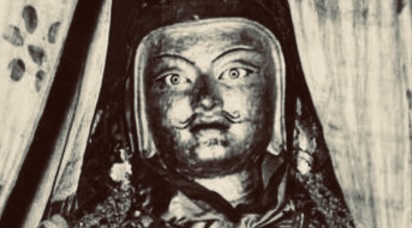
And then there are the stories, especially the extraordinary life of Guru Rinpoche. Guru Rinpoche isn’t just a figure from the past—he’s a living presence in the Vajrayana tradition, a practice, and a teaching all at once. His stories are filled with magic, mystery, and an energy that defies all logic. They show us a world that is far richer and more layered than the one materialism presents to us. These stories aren’t meant to be rationalized, they are meant to open your heart and mind to a sacred reality that transcends conventional thinking.
Guru Rinpoche represents the perfect union of wisdom and skillful means. A master embodying the sacred in every action, every word, every thought. His life and teachings challenge everything we’ve been conditioned to believe in, especially in the West. They invite us to step into a reality where the sacred is everywhere, where nothing is mundane, and where every aspect of life is alive with meaning.
A humble reflection
Writing these reflections has been a way for me to gather my thoughts on what feels essential: dignity, beauty, and the sacred. These are not luxuries. They are the foundation of what makes makes us human and what makes live meaningful. And yet they seem to be slipping further away in the modern world. I’ve seen this loss in myself, in the culture I grew up in, and even in the ways we sometimes approach spirituality.
For me, the journey toward rediscovering these qualities has been shaped by the teachings of the great masters I’ve been fortunate to meet, and by the example of simple lives lived with dignity and care, like my grandparents. Their quiet humility and sense of meaning, rooted in something beyond themselves, have stayed with me as a reminder of what we’ve largely lost, but what we can find again.




 Steps into stillness