How One Line Touched Me

Reflections on Lineage, Blessing, and the Living Transmission of Dharma


“It’s not the appearances that bind you, but the attachment to the appearances.”

I came across this line some years ago, in a book by Chögyam Trungpa Rinpoche. I don’t remember which book — perhaps The Myth of Freedom or Cutting Through Spiritual Materialism — but I remember the moment clearly. The sentence struck me as something complete in itself. It had the ring of an instruction, not just an idea. It didn’t feel like a phrase meant to be pondered, but something to be practiced.

It is often attributed to Tilopa, spoken to his disciple Naropa. And even if the exact wording may vary, the essential insight is unmistakably Mahāmudrā: the problem is not appearances themselves, but the way we relate to them. We don’t suffer because of what arises in our minds or senses — we suffer because we grasp. Because we take appearances to be solid, external, other. We believe in their inherent existence, and that belief binds us.

From the perspective of Mahāmudrā, we are not instructed to reject appearances, nor to improve them. We are asked to look directly at the nature of mind, to see that appearances are not outside of mind, not other than awareness, not ultimately real. They are vivid, luminous, and empty. To take them as real is to fall into dualism. To see their nature is liberation.

This sentence — “It’s not the appearances that bind you, but the attachment to the appearances” — gives us that instruction in just a few words. It’s a pith teaching: precise, unadorned, and true. It cut through a layer of habitual thinking for me. But what touched me most wasn’t only the content of the teaching. It was the fact that I was reading it at all.

Detail from a Sankrit version of ”The Perfection of Wisdom in Eight-Thousand Stanzas (Skt. Aṣṭasahāsrikā Prajñāparamitā) by the scribe Sujātabhadra, Katmandhu, around the 10th to 11th century CE, The times of Tilopa, Naropa

It had somehow reached me.

I was holding a Western-printed Dharma book, in English. And this sentence — born in India perhaps a thousand years ago — still worked. It was still alive. It carried weight. And that weight came not only from its meaning, but from its source. It had reached me through lineage.

That realization brought a kind of awe.

Because how does such a line survive?

How does something spoken in an ancient Indian dialect, possibly in the open air between a realized master and a committed disciple, find its way across language, culture, war, exile, and time — and appear before me now, on the printed page?

The short answer is: it survived because people cared. People practiced. People endured. It didn’t reach me only because it was written down. It reached me because it was remembered. Realized. Transmitted.

Tilopa gave this teaching to Naropa, not as a concept, but as a pointing-out instruction — introducing him directly to the nature of mind. Naropa himself had been a brilliant scholar, a master at Nālandā, well-versed in logic and scripture. But Tilopa dismantled that. He gave Naropa trials. Not metaphors — real trials. Hunger, exhaustion, humiliation. All to cut through pride, and to rip away the subtle layers of belief in solidity. After years of hardship, Naropa received the essence.

And then came Marpa — the Tibetan translator. Marpa crossed the Himalayas to India, not once but several times, at immense personal risk. He faced thieves, famine, political instability, and illness. He offered everything he had to receive teachings, and he brought them back to Tibet — not just in writing, but in his heart.

detail from an 18th-century tanka painting featuring the sage Milarepa

Marpa passed this realization to Milarepa — a figure often romanticized, but whose life was marked by immense difficulty. Marpa made him build and destroy stone towers again and again before giving him the teachings. Milarepa meditated alone in high mountain caves, wearing only a cotton cloth through the winter. He lived on nettles and snowmelt. But he attained realization, and his songs are still sung.

From Milarepa came Gampopa — a monk, physician, and master. He received Mahāmudrā from Milarepa and merged it with the Kadampa monastic tradition. From him arose the Karma Kagyü lineage. And from there, the transmission continued through the centuries — from teacher to student, sometimes in monasteries, sometimes in caves, always heart to heart.

But that wasn’t the end of the journey. There were centuries of hardship still to come.

In the 19th century, great masters like Jamgön Kongtrul Lodrö Thaye and Jamyang Khyentse Wangpo, foreseeing the fragility of many teachings, began the Rimé movement. They collected lineages, recorded oral teachings, and ensured that instructions like this one would not be lost.

And then came the catastrophe of the 20th century. The Chinese invasion of Tibet. The destruction of monasteries. The deaths of great teachers. And once again, the teachings survived — not because they were hidden away, but because they were carried. Carried by monks and yogis on foot, crossing snowy passes, starving, leaving behind texts but never letting go of what they had practiced and realized.

Many of those teachers reached India, Nepal, and Bhutan. And from there, some crossed oceans. They came to the West — into a world with little context for what they brought. And they still taught.

Among them was Chögyam Trungpa Rinpoche.

Trungpa Rinpoche probably early 80’s

Trungpa Rinpoche was no ordinary scholar. He had trained in the traditional monastic system, but also studied at Oxford. He understood both the depth of Tibetan Dharma and the difficulty of conveying it in the modern world. He saw the risk of misinterpretation. But he didn’t dilute the teachings. He found a new language for them — not by simplifying their meaning, but by cutting through the veils of cultural confusion with shocking clarity.

And through that effort, this sentence appeared in English. And it reached me.

It wasn’t just a phrase on a page. It carried something. I could feel it. A weight, a warmth — a kind of blessing. Because it had passed through Tilopa, Naropa, Marpa, Milarepa, Gampopa, Jamgön Kongtrul, and many others — not in theory, but in practice. Not just in language, but in realization.

And it reached me not only because of them — but also because of the teachers I have met in this life.

I’ve had the rare and humbling opportunity to meet realized masters, who helped me understand that these teachings are not just words. They are living transmissions. Without such teachers, I don’t believe I could have understood what this line really meant. Not from the outside. Not just as philosophy. But as something I could taste. Something that points to the actual nature of experience — beyond concepts.

This is what lineage is. Not just a list of names, but a thread of living understanding. And when that understanding is received, something shifts. You realize you’re no longer just a reader. You are part of something — even if you feel unworthy, even if you’ve barely begun to practice it. You’ve received it.

And that means: now it’s your turn.

Not to teach. Not to repeat. But to live it. To practice. To preserve the clarity. And eventually, maybe, to pass it on — not as a slogan, but as something you’ve truly come to understand.

“It’s not the appearances that bind you, but the attachment to the appearances.”

This line is not just a relic. It is a living instruction.

And for that — for the lives, the hardships, the memory, the love, the caves, the ink, the tears, the devotion, the silence — I bow my head. I feel deep, unshakable gratitude. And with it, a sense of quiet responsibility.

Because this is how the Dharma continues.

Through devotion.

Through practice.

Through blessing.

Through us.

Meditating with my friend Rinchen at a cave where Naropa is said to have meditated — Sankhu, Nepal, February 2025.
Bridging perspectives at 30,000 feet

There’s something strangely intimate about airplane conversations. Suspended thousands of feet above the earth, sealed inside a metal tube hurtling across the sky, time seems to loosen its grip. Perhaps it’s the shared vulnerability of being neither here nor there, or the fleeting certainty that these exchanges exist in a pocket outside the demands of daily life. Whatever it is, I’ve noticed it happens often to me. Almost every time I travel by plane, I end up in conversation with someone remarkable. But perhaps it’s not that I’m unusually lucky—maybe it’s that everyone becomes remarkable when you really listen.

On this flight from Amsterdam to Istanbul, I find myself next to a sturdy, tall man with Asian features. There’s something about the openness in his eyes—clear, curious, and unguarded. Before long, we’re talking.

“Short transfer in Istanbul as well?” I ask.

He smiles, and the conversation begins.

When I mention that I’m on my way to Kathmandu, he raises an eyebrow and smirks. “Ah, so you’re one of those hippies? Going to smoke hashish in the mountains?”

I laugh. “Well, do I look like a hippie who smokes hashish? I mean, I do have long hair.”

He chuckles, and I let the humor linger. It’s a light moment, one I don’t feel the need to explain. The truth is, my hair isn’t about style or rebellion—it’s part of my yogic tradition. But honestly, it doesn’t matter much to me what people think.

When I tell him I’m not traveling for leisure, but for a Buddhist pilgrimage, I see his curiosity sharpen. His posture shifts slightly, and the chatter of the cabin seems to recede as we lean into a conversation that feels less like small talk and more like discovery.

I learn that he’s Uyghur. He came to the Netherlands years ago as a refugee, spent two years in a refugee center, and eventually became a Dutch citizen. He’s lived in the Netherlands for a long time now, long enough to understand Dutch culture—not just its surface politeness, but the deeper rhythms of its modern life.

He shares openly about his experiences—his search for meaning, his frustrations with modernity, and the sense of emptiness that followed years of living a lifestyle shaped by Western ideals. He speaks candidly about things he struggled with: dating culture, fleeting connections, the party life that promised so much excitement but delivered so little satisfaction.

Screens, apps, and endless options—all of it created the illusion of abundance, but left him feeling isolated and unfulfilled. Over time, he realized there had to be more to life than what the modern world was offering.

In response, he returned to Islam. It wasn’t a dramatic moment of revelation, but a gradual return—an anchoring into something older, something solid. He speaks about his faith with warmth and clarity, and there’s a quiet strength in the way he carries it.

But beneath his calm and steady demeanor, there’s also pain—a deep, unspoken hurt that surfaces briefly when he shares a more personal story. His mother was in a re-education camp for two years. He doesn’t say much about it, but the weight of it hangs in the air between us. There’s a fragility in his voice when he mentions it, and I can see the trauma in his eyes, even if he doesn’t put it into words.

I don’t push further. Some silences are better left undisturbed, some pain too raw to probe. Instead, I listen, offering space for whatever he feels comfortable sharing.

When our conversation drifts to Buddhism, he already knows that it doesn’t involve a creator deity. But when he asks how Buddhists understand the source of everything, I feel myself treading carefully.

“What many faiths might call God,” I begin slowly, “we’d call Buddha Nature or True Nature. It’s not an external being or a creator overseeing the universe. It’s… the essence of everything. The ground of being itself.”

He listens, his brow furrowed slightly in thought.

“But at the end of the day,” I continue, “mind is at the heart of it all. In Buddhism, everything—every experience, every appearance—depends on the mind. The world we see, the suffering we feel, the peace we might find… it all comes back to the mind.”

I can sense the conversation reaching a threshold. The nuances of these concepts are difficult to express, especially to someone whose worldview is shaped by an Abrahamic perspective. It’s like trying to explain color to someone who’s only seen shades of gray—not because they lack understanding, but because the frameworks are fundamentally different.

Yet, we find common ground again when we speak of Sufi mysticism—of Rumi and Hafiz. There’s admiration in his voice, but also caution.

“It’s beautiful,” he says softly, “but also… dangerous.”

I tread carefully here. I don’t push, don’t press. Instead, the conversation lingers in that space between admiration and caution, remaining open, respectful, human.

Throughout our exchange, I notice something about him—an unspoken dignity, a quiet directness. There’s a clarity to him, a grounded confidence in how he carries his faith and his values. It’s a quality I’ve noticed before in Tibetans I’ve met—a kind of warrior-like presence, not in aggression, but in steadfastness. A quality that combines deep humility with an unshakable sense of purpose.

It’s inspiring. And it reminds me that we, as Western Buddhists, have something to learn here. Too often, Buddhism is perceived as abstract, overly philosophical, or detached. But that’s not the Buddhism I know. Guru Rinpoche embodies this perfectly—a figure of unwavering clarity, directness, and confidence.

We, too, need to exude that confidence. Not in a way that’s aggressive or rigid, but in a way that carries the weight of conviction—lived, embodied, and unshakable.

The hours pass unnoticed as we speak—nearly the entire three-and-a-half-hour flight. Faith, life, culture, politics, the emptiness of modernity, and the search for meaning—we cover everything, flowing seamlessly from one topic to the next.

As I walk through the sprawling airport, softly reciting mantras under my breath, I feel a deep sense of lightness—almost floating, yet firmly rooted.

Istanbul—Constantinople, as I still sometimes call it—is a place steeped in history, where East and West have always met.

This encounter feels like the perfect beginning to my journey. A reminder of why I travel—to broaden my horizons, to meet people who challenge and inspire me, and to carry their stories with me.

The path ahead feels alive with possibility. My heart feels open, my steps feel light, and a faint smile lingers on my lips as I walk towards my gate, mantras humming softly in my mind.

Treading the Footprints of the Mahāguru

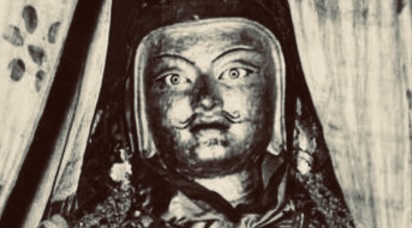
When I heard his name for the first time, it struck me—sharp, electric, like magnetic lightning through my chest. I had seen his face before, in The Tibetan Book of Living and Dying. I remember being transfixed by the stillness, the piercing gaze, the quiet power held in that image. But when my teacher spoke his name—Guru Rinpoche—it wasn’t just sound; it was force. It moved through me, unlocked something vast and impossibly familiar. It felt like something I had always known, yet it was the first time I had heard his name spoken.

From that moment on, something stayed with me. Guru Rinpoche was no longer just an image or a name in a book—he became a question, a pull, a mystery I couldn’t turn away from. I wanted to understand who he was.

That question stayed with me, quietly shaping my path, guiding me to books, teachers, situations and encounters. It wasn’t always clear, but it was always there—a thread running through my life, drawing me closer to something I couldn’t fully name but deeply recognized.

Now, as I prepare to visit the places where Guru Rinpoche meditated and taught, I feel that same pull, that same thread, that same presence leading me.

It was only later that I came to understand more about who my first teacher who introduced me to Guru Rinpoche truly was. He was recognized as a tertön, a treasure revealer, and an incarnation of Nanam Dorje Dudjom—one of Guru Rinpoche’s closest disciples. It was Nanam Dorje Dudjom, together with others sent by King Trisong Detsen, who stood at the border, welcoming Guru Rinpoche as he crossed from Nepal into Tibet, carrying the blessings that would establish Buddhism in the Land of Snow.

In earlier lives, Nanam Dorje Dudjom is said to have been one of the brothers who helped construct the Boudhanath Stupa, a monument of immeasurable spiritual significance. Those who participated in its creation are said to have been reborn as key figures in the spread of the Dharma in Tibet.

Jigme Phuntsok Rinpoche, also recognized as an incarnation of Nanam Dorje Dudjom, once wrote about the Boudhanath Stupa:

‘This stupa is not merely a structure; it is a mandala of awakened wisdom, a gateway to blessings beyond measure.’

These threads—spanning lifetimes, sacred sites, and spiritual teachings—are pulling me forward now, drawing me towards this journey. As I prepare to visit Nepal, to circumambulate the Boudhanath Stupa, and to offer prayers at the caves where Guru Rinpoche practiced, I feel immense gratitude for this opportunity.

True peace, lasting liberation, is found within the mind. That’s the essence of the Buddhist path. Yet the mind is easily swayed, distracted, and obscured. Sacred places act as powerful supports—they sharpen intention, still the mind, and most importantly, They are a support in helping to create merit or positive energy. Without merit, even the clearest teachings cannot take root, Even the simplest of intentions cannot be manifested into reality

Nepal holds some of those powerful places of support. Sacred sites where Guru Rinpoche meditated, where his realization left an imprint on stone and earth, where prayers have been carried into the wind and lifted by the smoke of sang offerings for centuries. At the Boudhanath Stupa, under its watchful ancient gaze, prayers rise—for healing, for clarity, for the true happiness of enlightenment, for the ultimate liberation of all sentient beings.

These sacred places are not separate from the mind. They are reflections of it. The mountains, the caves, the stupas—they remind us of boundless compassion and the wisdom that sees the true nature of reality, and unshakable courage already present within, waiting to be uncovered.

What might seem like ordinary stone and earth to some, for those who look deeper, shimmers with blessings—imbued with centuries of aspirations and prayers, offered by great masters and countless humble practitioners, many whose names we’ll never know. These places are not just remnants of the past; they are living mandalas, vibrant and alive, rich with presence, and luminous with the blessings of the Lotus-Born Guru.

And so, I follow these ancient threads—threads of prayer, devotion, and realization—into the heart of Nepal, stepping onto the physical ground where countless others have prayed before, carrying the quiet hope that these blessings may ripple outward, touching hearts and lives far beyond my own.