

My Second Day in Kathmandu
I woke up before dawn, somewhere around four, when the monastery bells began to ring through the courtyard of the Shechen Guesthouse. I was still jet-lagged and woke early, and the dogs had already started barking. I recited a short prayer ”invoking the Lama from afar” from the Longchen Nyingtik lineage. It was a good start of the day, invoking the Lama’s compassion and presence for the day.
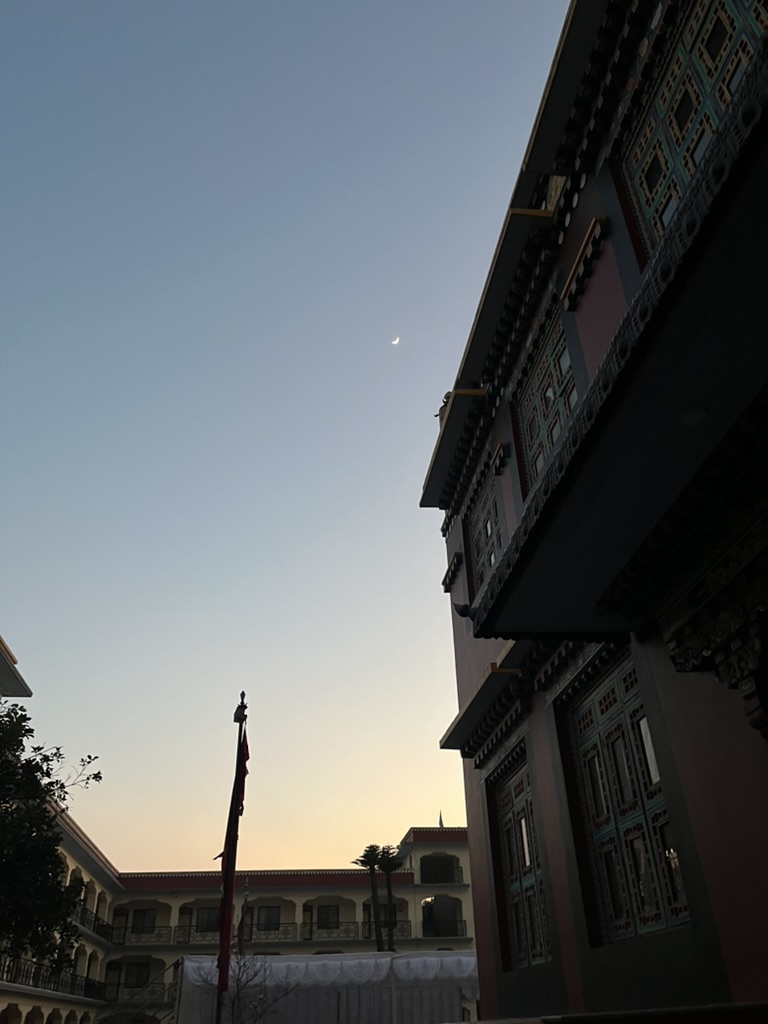
By the time I stepped outside, it must have been around five-thirty. The sky was still dark, though softening, and the first hints of light were rising behind the rooftops. The monastery grounds were quiet, the stones under my feet still damp from the night. The gatekeeper opened the gate for me with a warm, sleepy smile.
After stepping outside, the alley was mostly empty. A few dogs wandered around, a single person was sweeping the dust from a shop front, and further down, an Agor yogi wrapped in his black cloth moved slowly at his own pace.
As I continued down the alley, the air carried the smell of incense offered by shopkeepers in front of their stores. I stopped to buy sang from an older Tibetan-looking woman with kind eyes. I made a small gesture, and she understood immediately. She seemed happy to help me with it. I also bought a few flowers to offer at the stupa later.
A friend at Rangjung Yeshe had once told me about a small park called Budapark on the Shechen side of Boudha, where a large Guru Rinpoche statue overlooked a pond. She used to practice there. I followed her advice and found it easily. The air was fresh and cold. A handful of Himalayan elders were already circumambulating the statue, chanting quietly, their prayer wheels turning in steady rhythm. The big sang pot glowed with embers.
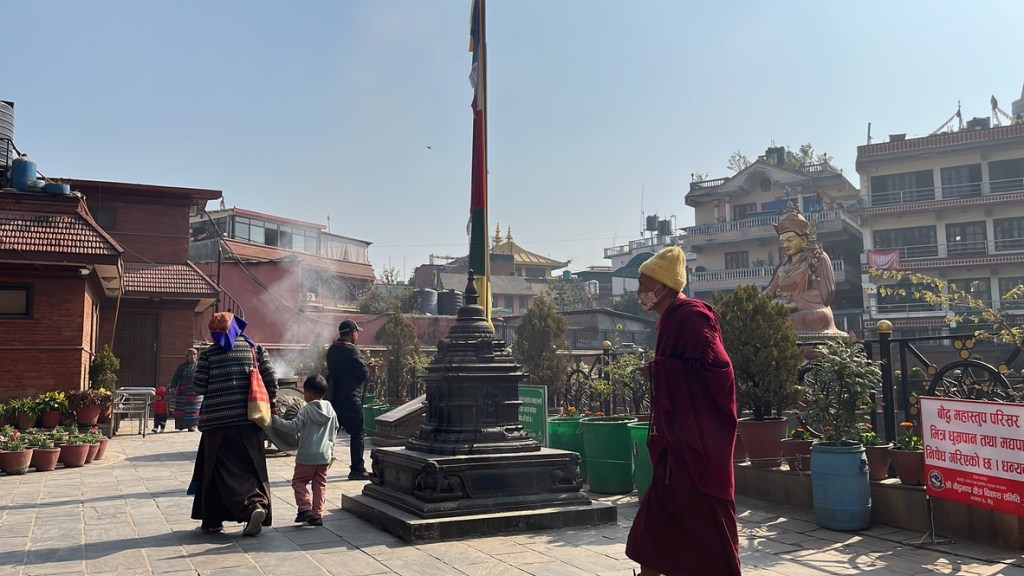
I offered sang, then made a few kora. Afterwards I sat on a bench. An elderly man came to sit next to me. He might have been in his late sixties, but he looked older, as often happens with people who have spent most of their lives outdoors. Yet his eyes were bright and gentle. He was likely from the Tamang community.
I opened my practice book and began my morning prayers. As soon as I started chanting in Tibetan, he turned toward me and began speaking, assuming I understood. I had to gesture that I didn’t. There was a short, awkward pause, almost like a moment of disappointment. When I turned to the 21 Taras, he joined in smoothly, knowing every syllable by heart. It wasn’t him joining me; we were practicing together, and at that moment the awkwardness dissolved. We met in the language of practice. It was quite special for me.
Other people came and went. A Tibetan woman paused to peek into my practice book, something that would feel a little nosy in Europe, but here her curiosity was innocent and warm. She smiled and continued her kora. The combination of sang smoke, mantra chanting, the sound of prayer wheels, and the first morning light made the place feel like a living mandala.
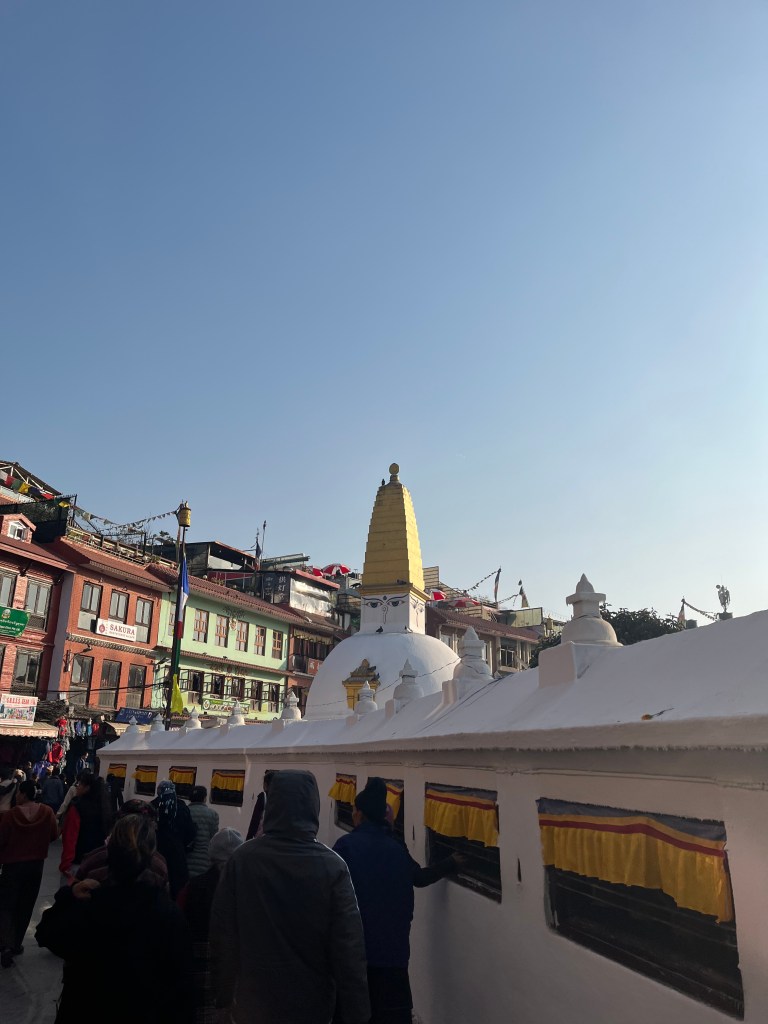
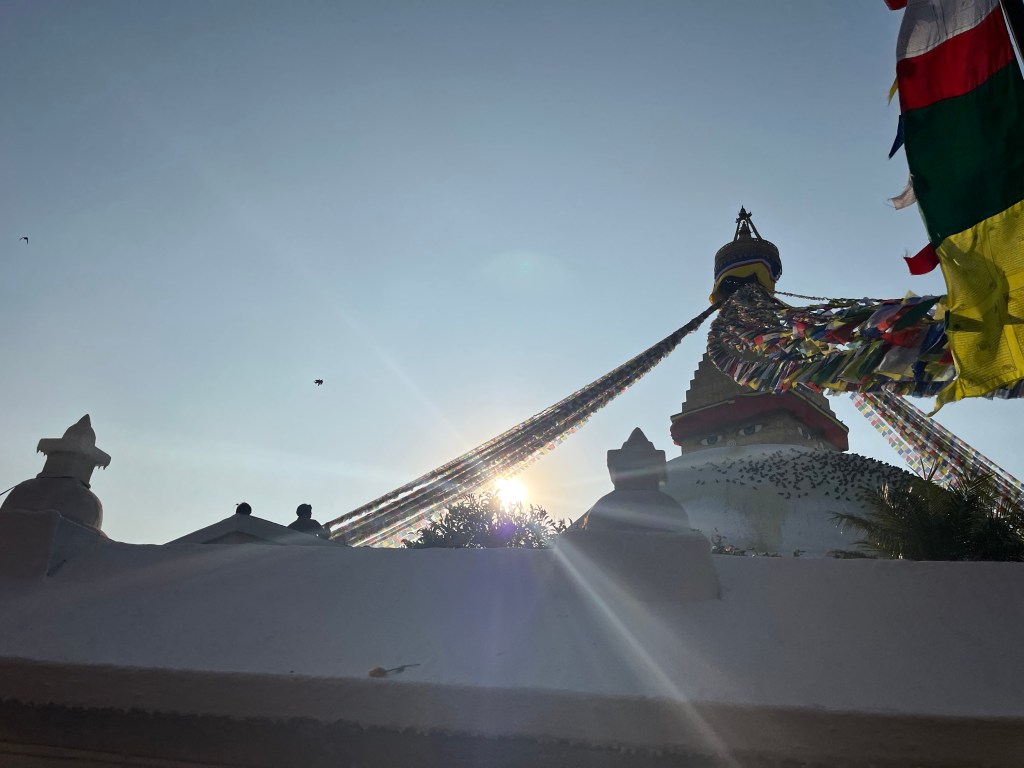
After sunrise I bought yogurt and fruit from a vendor and sat on a low, ancient stone wall — one of the carved water points around Boudha, worn smooth over centuries. Then I headed toward the stupa. By then the early stillness had shifted into the familiar rhythm of Boudha: monks arriving, devotees flowing clockwise around the kora.
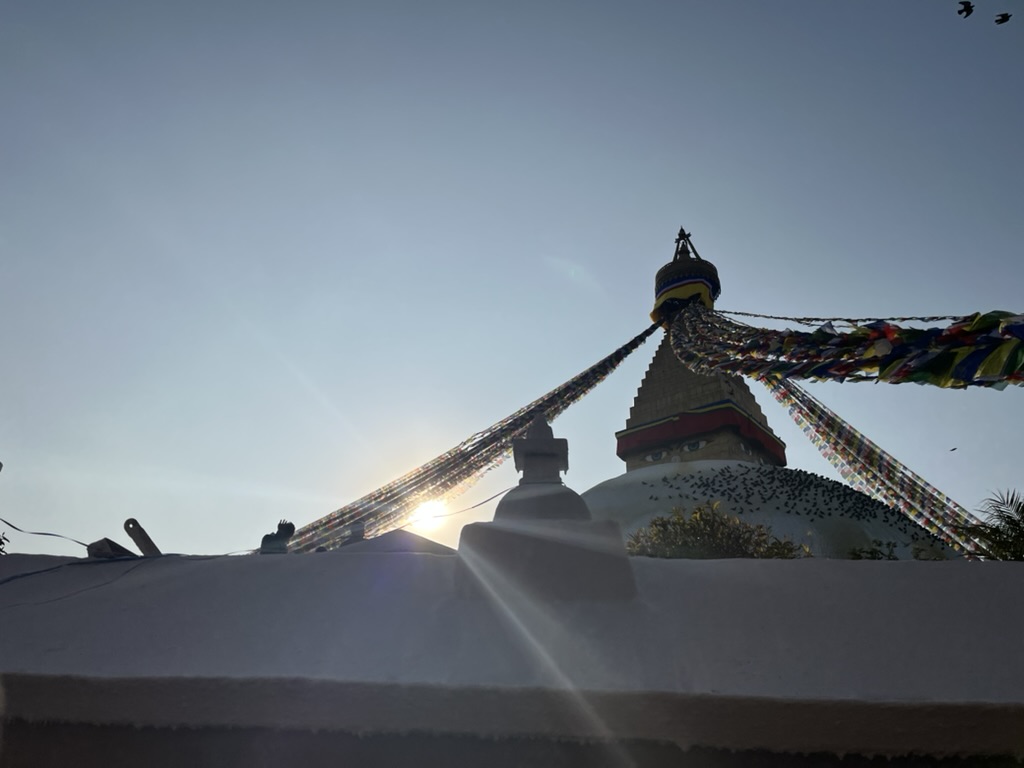
Inside the inner kora, it was still cold. Several people were already doing prostrations. I began my Tröma ngöndro, without instruments, I had brought Vajra, bell, damaru, and kangling simply on intuition. I planned to use it but had no idea where or how — it just felt right to carry them.
After the purification section, I took off my jacket. It slipped from my hands and fell to the ground. My phone was inside it, so I quickly checked if it was cracked. It was fine — but a Facebook notification had appeared. The day before, I had commented on a post by Pema Yödrön — who would, unknowingly to me then, later become a spiritual companion along the path. Someone named Padma Vajra had also replied, and his comments were thoughtful, grounded, and clearly written by someone who genuinely practiced. Still, Kathmandu has its share of self-proclaimed yogis, so I wasn’t sure what to make of him.
Without thinking — almost too fast to stop myself — I opened Messenger and typed:
“Hey man, want to grab a coffee?”
It was a message I sent before I even had time to think, or take it back.
Ten minutes later he replied:
“Yes, brother. I’m doing a puja nearby. We can meet in an hour.”
It felt auspicious. I finished my practice, and as soon as I wrapped up, another message arrived:
“I’m here. Where are you?”
I walked to the gate of the inner kora and saw him approaching. Relief washed over me — he looked grounded, warm, genuine. Not inflated, not trying to impress. We greeted each other with folded palms, and when I looked into his eyes I saw how sharp and kind they were, bright and steady at the same time. He had long black hair, deep dark skin, and a calm, clear way of carrying himself. His voice, when he spoke, was deep yet open.
I noticed a natural balance between the masculine and the feminine — a quality I’ve often seen in good dakini practitioners. His energy was steady but soft, direct yet receptive. He asked me a few simple questions, nothing heavy, but enough to feel he was meeting me from a real place.
He wore an Indian-style sleeveless jacket and a white nakpa skirt. And I, by coincidence — or maybe not — had worn my grey nakpa skirt that same morning. In the Düdjom context this is a clear sign, and one of the first things he asked was whether I was Düdjom.
After meeting at the gate, we walked a few koras around the stupa together. It felt easy and natural, as if we had known each other longer than a few minutes. I noticed we were the only ones carrying heavy bags around the stupa, with our texts and instruments inside, and at one point I joked, “It’s not easy being a Tröma practitioner.” He laughed and said, “Yeah, we have to carry everything.”
After that we stopped for tea at a tea shop right next to the kora, a place he often goes. We talked for maybe five or ten minutes. In that short time we realised we had a surprising amount in common — our devotion to the same teachers, our strong connection to the lineage, and even the same practice. It turned out he knew my previous companion on the path, and that they have the same teacher, an unknown but highly realised yogi from Tso Pema whom not many people know about. It was remarkable how much we shared, and it made me feel even closer to him.
At one point, very naturally, he said, “Let’s go and practice. I know a perfect place.” There was no hesitation in him. We weren’t here to sit next to the Boudha Stupa and talk endlessly about Dharma without living it. We were there to practice after all. I had brought my text, bell, and damaru without knowing where I would use them. Suddenly, it made perfect sense.
First we went to buy some fruit and a small bottle of alcohol for the offerings. Padma also needed to pick up a few things from the place where he was staying. He told me he was only in Boudha for a few days, which made our meeting feel even more like perfect timing.
He was staying with an American woman who worked as a Tibetan translator. He introduced me to her briefly. She had a crisp, lively, very talkative energy — the quick, slightly intense kind you often see in bright intellectuals. When she stepped back inside, I quietly asked him, “Is she Jewish?”
He laughed and said, “Yeah, she definitely is,” and we walked on.
Outside, Padma showed me which taxi app everyone in Kathmandu uses. We ordered a taxi. Just as we were about to get in, we suddenly ran into another yogi-teacher he knew — someone from the Longchen Nyingtik lineage. He greeted Padma warmly, gave me a small nod, and we told him where we were going. It felt like a good tendrel for the rest of the day.
We got in the taxi.
On the way we talked easily. Padma pointed out the different districts of Kathmandu — which areas belonged to which Newar communities, which neighbourhoods had old practice grounds, which parts of the city still held traces of earlier centuries. He knew a lot, and the conversation was genuinely interesting. We enjoyed ourselves, talking about the valley, about practice, and about ordinary things as well.
When we arrived near the temple, we walked up a short path with our heavy bags. As we were walking, Padma told me that Vidhyeshvari sits along the Bisnumati River, in what used to be the great charnel ground of Ramadoli — a place where siddhas like Thangtong Gyalpo, Marpa Lotsawa, and Vanaratna had practiced. He explained how, in earlier centuries, the whole area had been one continuous cremation ground stretching toward the confluence of the Kusumavati and Kesavati rivers.
He also said that a small part of the cremation ground is still active today, where Buddhist families continue to cremate their dead. “Maybe we can practice there one day,” he added. Hearing all of this while walking up toward the shrine with my heavy bag, I felt as if we were entering ground with a deep history and very strong blessings. I felt genuinely fortunate to practice in a place like this — amazing that it still exists after so many centuries.
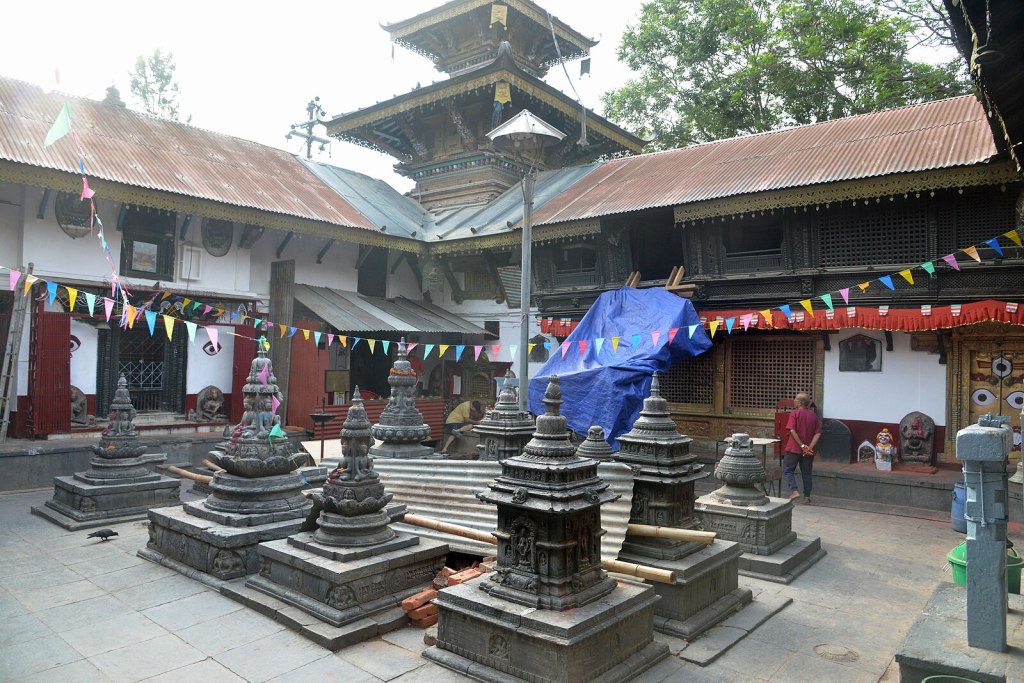
At the top of the path, the courtyard opened into a small cluster of very old stupas, their surfaces worn smooth by time. These were the old Newar-style stupas you only find in older temple complexes around the valley. We did a few koras around them, and as we walked, Padma explained the symbolism — the base, the steps, the harmika, the spire — and the particular shapes used in the Newar tradition. He knew all of this very naturally, not in an academic way, but like someone familiar with the place.
After the koras, he greeted one of the Newar priests he knew well and introduced me. Padma is incredibly good at connecting with different cultures. Being Indian himself, yet fluent in Tibetan and Nepali, he moves between these worlds with ease. People here seemed to know him and respect him.
We lit a few butter lamps for the Yogini and then stepped toward the inner shrine.
That was the first moment I saw her.
Her eyes looked alive.
For a moment I genuinely thought someone was sitting inside the shrine looking back at us. Beneath the Newar-style ornamentation, the soot, and the centuries of offerings, the presence was so embodied and immediate that it startled me. It touched me very directly, and my heart and mind opened instantly with her presence.
She was alive. She was there.
We arranged the offerings — the fruit, the alcohol, and his kapala — and then took out our texts and instruments. Padma explained quietly what we would do, which practice, how he wanted to structure it, and when he wanted me to take the chöpen part. I felt a little nervous — I’m not very used to doing the chöpen, especially not in a public place like this.
We sat upright and began with the nine purification breaths. The air in the shrine was cool and still. After that we settled our breath, and then we began the practice.
Within a few minutes, the nervousness fell away completely. The practice started to move on its own, as if it carried us rather than the other way around. Our voices harmonized very naturally, the rhythm of the drum settled between us, and everything felt aligned.
The drum echoed against the stone walls in a deep, resonant way, filling the cold, empty room with the familiar warmth of the practice. As the rhythm settled, I felt surprisingly at home in this strange environment.
People moved in and out of the shrine in their own rhythm. Some came to offer butter lamps, others murmured prayers under their breath, and a few spoke in Nepali to the Newar priests. Tibetans and Himalayan devotees spoke among themselves in Tibetan, sometimes quietly, sometimes quite animated, but somehow it didn’t disturb me. It was simply part of the practice.
At one point, three nuns entered. They had that unmistakable steadiness of long-time practitioners — calm, humble, self-contained. For a moment I felt slightly self-conscious, as if our louder style of practice filled the room while these quiet nuns carried far deeper experience. But they were respectful, and one of them even chanted softly with us for a few moments.
They didn’t stay long. When they left, they gave us a small, warm, knowing smile.
Later, during a short break, Padma told me that they were Düdjom nuns. We both felt it immediately — a blessing from the dakinis, an unmistakably auspicious moment appearing right in the middle of the session.
Sometime during the practice, something shifted inside me. Beneath the loudness of the drum and our voices, the room suddenly felt still. I felt engulfed in white light, almost dissolving into it, neither fully here nor there. It felt as if the dark shrine was lit from within; the presence of the Yoginī was unmistakable.
Padma told me it was time to arrange the offerings. I was a bit nervous, but he instructed me clearly what to do. The Newar priest also gestured where to place the fruit and the alcohol, and I followed his indications.
At one point, a few Himalayan devotees came in. They watched us for a moment, made their own offerings, and even placed small amounts of money in our laps. It struck me how natural and beautiful this was — how practice is genuinely appreciated here. Later, I offered the money to the Newar priest.
When it was time to enjoy the tsok, Padma lifted the kapala and said we shouldn’t waste the alcohol. Only then did I realise I had poured far too much. So we ended up drinking more than planned. With the jet lag and the intensity of the session, it went straight to my head. I felt genuinely a bit drunk — light, floating, and almost dissolving into the practice itself. At one point Padma nudged me gently to remind me of my chöpen part.
When we finished the main section, we did strong dedication prayers. The room was filled with joy and contentment, the natural fullness of a complete session. We dedicated the practice to the lineage, to our teachers, and to all practitioners, and each of us added a few personal aspirations on top of the traditional verses. It felt simple and genuine.
When I packed my things afterward, I realised I must have been quite drunk. I hadn’t closed the alcohol bottle properly, and later I saw it had leaked onto my zen, leaving stains. They’re still there — a beautiful reminder of that very special first day in Nepal.
When we finally stepped outside, I realised how long we must have been inside. The sun was already low, the shadows long. We must have spent most of the day in that shrine without noticing. The world felt slightly different, as if something had shifted around us. Even walking down the steps felt new.
We found a small restaurant Padma liked. Modern lights, young people, good music. The contrast with the Yoginī shrine was almost unreal. Ten minutes earlier, we had been chanting in a centuries-old temple darkened by butter-lamp smoke; now we were sitting at a clean table eating fries.
What surprised me was how easy it was to talk with him. I began to see more of the man behind the practitioner — someone my age, from the same generation, shaped by modern culture. We talked about practice, relationships, childhood, family, how we grew up. It felt open and natural, as if we had known each other longer than a single afternoon.

At one point a line from Casablanca came to mind:
“Louis, I think this is the beginning of a beautiful friendship.”
I didn’t say it, but for a moment, looking at him, I thought he felt the same.
When we left the restaurant it was already getting dark. Kathmandu was settling into evening — the air cooling, dogs barking in the distance, the city folding into night. We walked for a bit, then took a taxi back toward Boudha. After we separated, I continued on foot and did a kora around the stupa. The prayer wheels turning in the dark, the butter lamps glowing, the smell of incense — all of it felt more intimate than the night before.
As I walked, I realised something very simple and very clear:
I didn’t feel like a visitor anymore.
Padma and I had met earlier that morning, literally at the gate of the inner part of the kora of the Boudhanath Stupa, which itself is a mandala. Meeting him there was highly significant: on an outer level, it was at the gate of the inner kora; on an inner level, it felt as if I was being introduced to the inner mandala of Kathmandu itself, moving from the outer layers of the city and stupa into the deeper flow of practice, lineage, and blessing. The encounter at that gate mirrored the unfolding of the day — everything had opened naturally, in perfect alignment.
Something in the valley had opened.
It felt as if the blessing of my Lama had created the conditions for this meeting, this practice, and for the whole day to unfold in exactly the way it did.
The meeting, the practice, the place, the timing — all of it had the quality of a good tendrel. I felt received by the mandala of the Kathmandu Valley. I felt at home.
From that moment on, I decided to go and practice at the seven Yoginī temples of this sacred valley.
If you’d like to know more about Padma Vajra, who organizes pilgrimages and retreats in Nepal, you can check out his Instagram page here. He’s an excellent and trustworthy guide for those interested in Buddhist (Vajrayana) practice and pilgrimage.



 Steps into stillness