I woke up before dawn, somewhere around four, when the monastery bells began to ring through the courtyard of the Shechen Guesthouse. I was still jet-lagged and woke early, and the dogs had already started barking. I recited a short prayer ”invoking the Lama from afar” from the Longchen Nyingtik lineage. It was a good start of the day, invoking the Lama’s compassion and presence for the day.
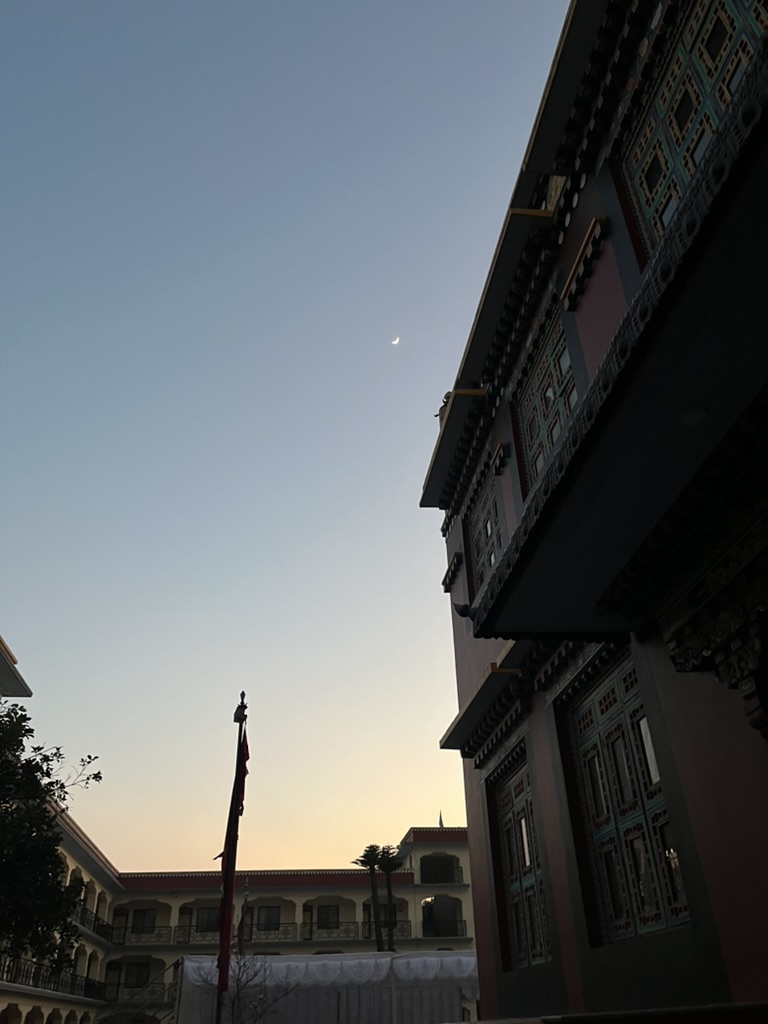
By the time I stepped outside, it must have been around five-thirty. The sky was still dark, though softening, and the first hints of light were rising behind the rooftops. The monastery grounds were quiet, the stones under my feet still damp from the night. The gatekeeper opened the gate for me with a warm, sleepy smile.
After stepping outside, the alley was mostly empty. A few dogs wandered around, a single person was sweeping the dust from a shop front, and further down, an Agor yogi wrapped in his black cloth moved slowly at his own pace.
As I continued down the alley, the air carried the smell of incense offered by shopkeepers in front of their stores. I stopped to buy sang from an older Tibetan-looking woman with kind eyes. I made a small gesture, and she understood immediately. She seemed happy to help me with it. I also bought a few flowers to offer at the stupa later.
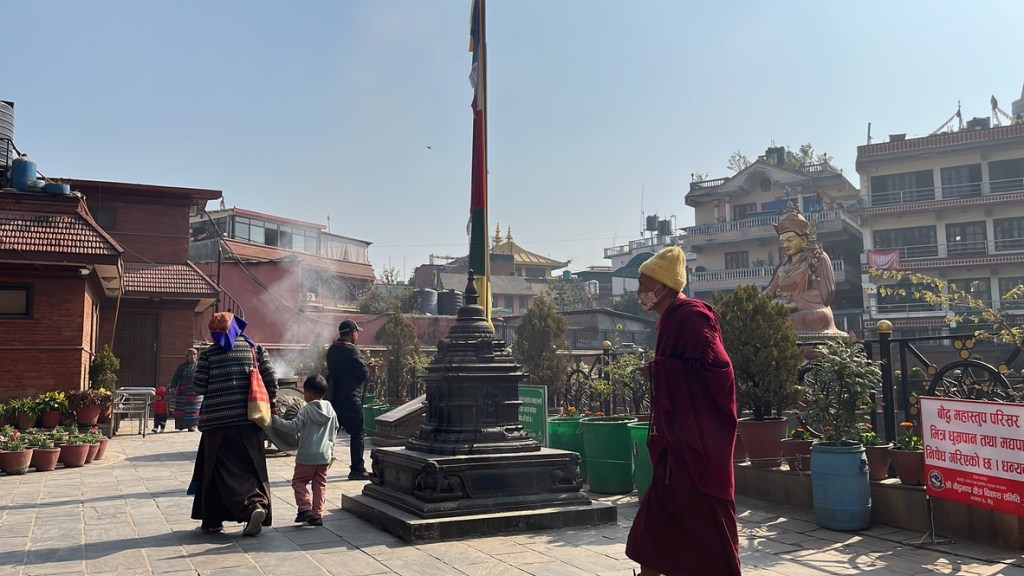
A friend at Rangjung Yeshe had once told me about a small park called Budapark on the Shechen side of Boudha, where a large Guru Rinpoche statue overlooked a pond. She used to practice there. I followed her advice and found it easily. The air was fresh and cold. A handful of Himalayan elders were already circumambulating the statue, chanting quietly, their prayer wheels turning in steady rhythm. The big sang pot glowed with embers.
I offered sang, then made a few kora. Afterwards I sat on a bench. An elderly man came to sit next to me. He might have been in his late sixties, but he looked older, as often happens with people who have spent most of their lives outdoors. Yet his eyes were bright and gentle. He was likely from the Tamang community.
I opened my practice book and began my morning prayers. As soon as I started chanting in Tibetan, he turned toward me and began speaking, assuming I understood. I had to gesture that I didn’t. There was a short, awkward pause, almost like a moment of disappointment. When I turned to the 21 Taras, he joined in smoothly, knowing every syllable by heart. It wasn’t him joining me; we were practicing together, and at that moment the awkwardness dissolved. We met in the language of practice. It was quite special for me.
Other people came and went. A Tibetan woman paused to peek into my practice book, something that would feel a little nosy in Europe, but here her curiosity was innocent and warm. She smiled and continued her kora. The combination of sang smoke, mantra chanting, the sound of prayer wheels, and the first morning light made the place feel like a living mandala.
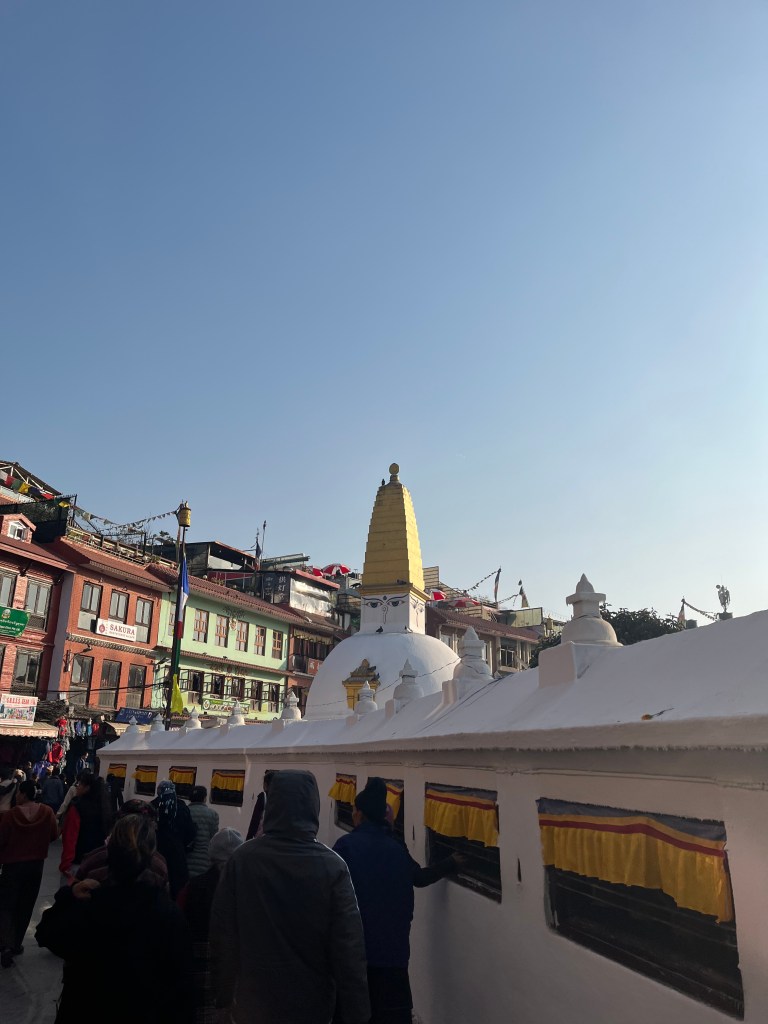
After sunrise I bought yogurt and fruit from a vendor and sat on a low, ancient stone wall — one of the carved water points around Boudha, worn smooth over centuries. Then I headed toward the stupa. By then the early stillness had shifted into the familiar rhythm of Boudha: monks arriving, devotees flowing clockwise around the kora.
Inside the inner kora, it was still cold. Several people were already doing prostrations. I began my Tröma ngöndro, without instruments, I had brought Vajra, bell, damaru, and kangling simply on intuition. I planned to use it but had no idea where or how — it just felt right to carry them.
After the purification section, I took off my jacket. It slipped from my hands and fell to the ground. My phone was inside it, so I quickly checked if it was cracked. It was fine — but a Facebook notification had appeared. The day before, I had commented on a post by Pema Yödrön — who would, unknowingly to me then, later become a spiritual companion along the path. Someone named Padma Vajra had also replied, and his comments were thoughtful, grounded, and clearly written by someone who genuinely practiced. Still, Kathmandu has its share of self-proclaimed yogis, so I wasn’t sure what to make of him.
Without thinking — almost too fast to stop myself — I opened Messenger and typed:
“Hey man, want to grab a coffee?”
It was a message I sent before I even had time to think, or take it back.
Ten minutes later he replied:
“Yes, brother. I’m doing a puja nearby. We can meet in an hour.”
It felt auspicious. I finished my practice, and as soon as I wrapped up, another message arrived:
“I’m here. Where are you?”
I walked to the gate of the inner kora and saw him approaching. Relief washed over me — he looked grounded, warm, genuine. Not inflated, not trying to impress. We greeted each other with folded palms, and when I looked into his eyes I saw how sharp and kind they were, bright and steady at the same time. He had long black hair, deep dark skin, and a calm, clear way of carrying himself. His voice, when he spoke, was deep yet open.
I noticed a natural balance between the masculine and the feminine — a quality I’ve often seen in good dakini practitioners. His energy was steady but soft, direct yet receptive. He asked me a few simple questions, nothing heavy, but enough to feel he was meeting me from a real place.
He wore an Indian-style sleeveless jacket and a white nakpa skirt. And I, by coincidence — or maybe not — had worn my grey nakpa skirt that same morning. In the Düdjom context this is a clear sign, and one of the first things he asked was whether I was Düdjom.
After meeting at the gate, we walked a few koras around the stupa together. It felt easy and natural, as if we had known each other longer than a few minutes. I noticed we were the only ones carrying heavy bags around the stupa, with our texts and instruments inside, and at one point I joked, “It’s not easy being a Tröma practitioner.” He laughed and said, “Yeah, we have to carry everything.”
After that we stopped for tea at a tea shop right next to the kora, a place he often goes. We talked for maybe five or ten minutes. In that short time we realised we had a surprising amount in common — our devotion to the same teachers, our strong connection to the lineage, and even the same practice. It turned out he knew my previous companion on the path, and that they have the same teacher, an unknown but highly realised yogi from Tso Pema whom not many people know about. It was remarkable how much we shared, and it made me feel even closer to him.
At one point, very naturally, he said, “Let’s go and practice. I know a perfect place.” There was no hesitation in him. We weren’t here to sit next to the Boudha Stupa and talk endlessly about Dharma without living it. We were there to practice after all. I had brought my text, bell, and damaru without knowing where I would use them. Suddenly, it made perfect sense.
First we went to buy some fruit and a small bottle of alcohol for the offerings. Padma also needed to pick up a few things from the place where he was staying. He told me he was only in Boudha for a few days, which made our meeting feel even more like perfect timing.
He was staying with an American woman who worked as a Tibetan translator. He introduced me to her briefly. She had a crisp, lively, very talkative energy — the quick, slightly intense kind you often see in bright intellectuals. When she stepped back inside, I quietly asked him, “Is she Jewish?”
He laughed and said, “Yeah, she definitely is,” and we walked on.
Outside, Padma showed me which taxi app everyone in Kathmandu uses. We ordered a taxi. Just as we were about to get in, we suddenly ran into another yogi-teacher he knew — someone from the Longchen Nyingtik lineage. He greeted Padma warmly, gave me a small nod, and we told him where we were going. It felt like a good tendrel for the rest of the day.
We got in the taxi.
On the way we talked easily. Padma pointed out the different districts of Kathmandu — which areas belonged to which Newar communities, which neighbourhoods had old practice grounds, which parts of the city still held traces of earlier centuries. He knew a lot, and the conversation was genuinely interesting. We enjoyed ourselves, talking about the valley, about practice, and about ordinary things as well.
When we arrived near the temple, we walked up a short path with our heavy bags. As we were walking, Padma told me that Vidhyeshvari sits along the Bisnumati River, in what used to be the great charnel ground of Ramadoli — a place where siddhas like Thangtong Gyalpo, Marpa Lotsawa, and Vanaratna had practiced. He explained how, in earlier centuries, the whole area had been one continuous cremation ground stretching toward the confluence of the Kusumavati and Kesavati rivers.
He also said that a small part of the cremation ground is still active today, where Buddhist families continue to cremate their dead. “Maybe we can practice there one day,” he added. Hearing all of this while walking up toward the shrine with my heavy bag, I felt as if we were entering ground with a deep history and very strong blessings. I felt genuinely fortunate to practice in a place like this — amazing that it still exists after so many centuries.
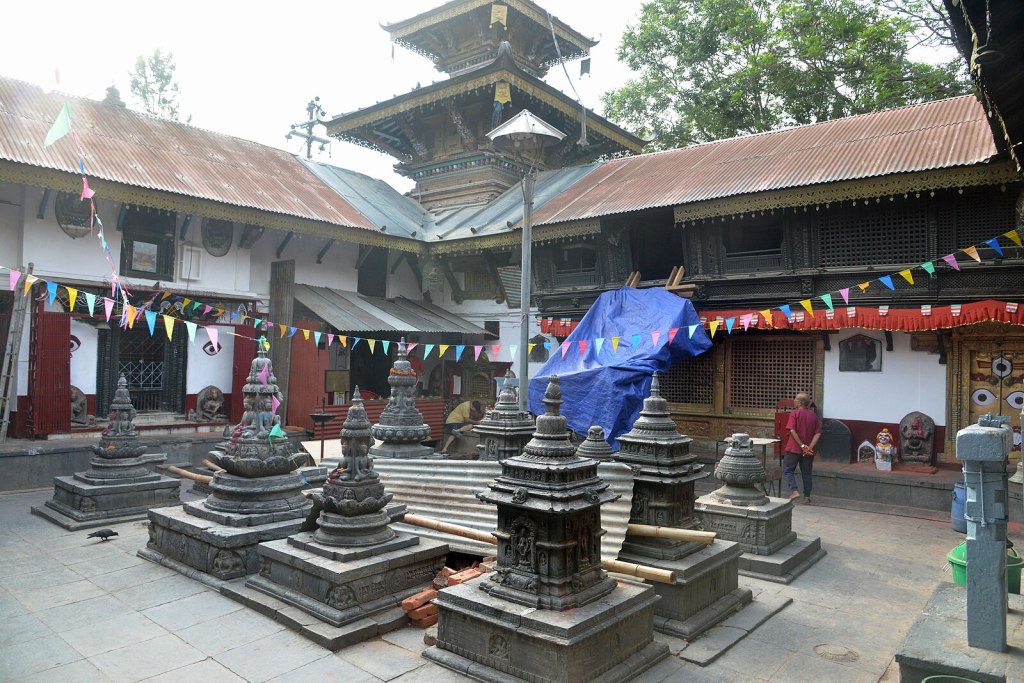
At the top of the path, the courtyard opened into a small cluster of very old stupas, their surfaces worn smooth by time. These were the old Newar-style stupas you only find in older temple complexes around the valley. We did a few koras around them, and as we walked, Padma explained the symbolism — the base, the steps, the harmika, the spire — and the particular shapes used in the Newar tradition. He knew all of this very naturally, not in an academic way, but like someone familiar with the place.
After the koras, he greeted one of the Newar priests he knew well and introduced me. Padma is incredibly good at connecting with different cultures. Being Indian himself, yet fluent in Tibetan and Nepali, he moves between these worlds with ease. People here seemed to know him and respect him.
We lit a few butter lamps for the Yogini and then stepped toward the inner shrine.
That was the first moment I saw her.
Her eyes looked alive.
For a moment I genuinely thought someone was sitting inside the shrine looking back at us. Beneath the Newar-style ornamentation, the soot, and the centuries of offerings, the presence was so embodied and immediate that it startled me. It touched me very directly, and my heart and mind opened instantly with her presence.
She was alive. She was there.
We arranged the offerings — the fruit, the alcohol, and his kapala — and then took out our texts and instruments. Padma explained quietly what we would do, which practice, how he wanted to structure it, and when he wanted me to take the chöpen part. I felt a little nervous — I’m not very used to doing the chöpen, especially not in a public place like this.
We sat upright and began with the nine purification breaths. The air in the shrine was cool and still. After that we settled our breath, and then we began the practice.
Within a few minutes, the nervousness fell away completely. The practice started to move on its own, as if it carried us rather than the other way around. Our voices harmonized very naturally, the rhythm of the drum settled between us, and everything felt aligned.
The drum echoed against the stone walls in a deep, resonant way, filling the cold, empty room with the familiar warmth of the practice. As the rhythm settled, I felt surprisingly at home in this strange environment.
People moved in and out of the shrine in their own rhythm. Some came to offer butter lamps, others murmured prayers under their breath, and a few spoke in Nepali to the Newar priests. Tibetans and Himalayan devotees spoke among themselves in Tibetan, sometimes quietly, sometimes quite animated, but somehow it didn’t disturb me. It was simply part of the practice.
At one point, three nuns entered. They had that unmistakable steadiness of long-time practitioners — calm, humble, self-contained. For a moment I felt slightly self-conscious, as if our louder style of practice filled the room while these quiet nuns carried far deeper experience. But they were respectful, and one of them even chanted softly with us for a few moments.
They didn’t stay long. When they left, they gave us a small, warm, knowing smile.
Later, during a short break, Padma told me that they were Düdjom nuns. We both felt it immediately — ablessing from the dakinis, an unmistakably auspicious moment appearing right in the middle of the session.
Sometime during the practice, something shifted inside me. Beneath the loudness of the drum and our voices, the room suddenly felt still. I felt engulfed in white light, almost dissolving into it, neither fully here nor there. It felt as if the dark shrine was lit from within; the presence of the Yoginī was unmistakable.
Padma told me it was time to arrange the offerings. I was a bit nervous, but he instructed me clearly what to do. The Newar priest also gestured where to place the fruit and the alcohol, and I followed his indications.
At one point, a few Himalayan devotees came in. They watched us for a moment, made their own offerings, and even placed small amounts of money in our laps. It struck me how natural and beautiful this was — how practice is genuinely appreciated here. Later, I offered the money to the Newar priest.
When it was time to enjoy the tsok, Padma lifted the kapala and said we shouldn’t waste the alcohol. Only then did I realise I had poured far too much. So we ended up drinking more than planned. With the jet lag and the intensity of the session, it went straight to my head. I felt genuinely a bit drunk — light, floating, and almost dissolving into the practice itself.At one point Padma nudged me gently to remind me of my chöpen part.
When we finished the main section, we did strong dedication prayers. The room was filled with joy and contentment, the natural fullness of a complete session. We dedicated the practice to the lineage, to our teachers, and to all practitioners, and each of us added a few personal aspirations on top of the traditional verses. It felt simple and genuine.
When I packed my things afterward, I realised I must have been quite drunk. I hadn’t closed the alcohol bottle properly, and later I saw it had leaked onto my zen, leaving stains. They’re still there — a beautiful reminder of that very special first day in Nepal.
When we finally stepped outside, I realised how long we must have been inside. The sun was already low, the shadows long. We must have spent most of the day in that shrine without noticing. The world felt slightly different, as if something had shifted around us. Even walking down the steps felt new.
We found a small restaurant Padma liked. Modern lights, young people, good music. The contrast with the Yoginī shrine was almost unreal. Ten minutes earlier, we had been chanting in a centuries-old temple darkened by butter-lamp smoke; now we were sitting at a clean table eating fries.
What surprised me was how easy it was to talk with him. I began to see more of the man behind the practitioner — someone my age, from the same generation, shaped by modern culture. We talked about practice, relationships, childhood, family, how we grew up. It felt open and natural, as if we had known each other longer than a single afternoon.
At one point a line from Casablanca came to mind:
“Louis, I think this is the beginning of a beautiful friendship.”
I didn’t say it, but for a moment, looking at him, I thought he felt the same.
When we left the restaurant it was already getting dark. Kathmandu was settling into evening — the air cooling, dogs barking in the distance, the city folding into night. We walked for a bit, then took a taxi back toward Boudha. After we separated, I continued on foot and did a kora around the stupa. The prayer wheels turning in the dark, the butter lamps glowing, the smell of incense — all of it felt more intimate than the night before.
As I walked, I realised something very simple and very clear:
I didn’t feel like a visitor anymore.
Padma and I had met earlier that morning, literally at the gate of the inner part of the kora of the Boudhanath Stupa, which itself is a mandala. Meeting him there was highly significant: on an outer level, it was at the gate of the inner kora; on an inner level, it felt as if I was being introduced to the inner mandala of Kathmandu itself, moving from the outer layers of the city and stupa into the deeper flow of practice, lineage, and blessing. The encounter at that gate mirrored the unfolding of the day — everything had opened naturally, in perfect alignment.
Something in the valley had opened.
It felt as if the blessing of my Lama had created the conditions for this meeting, this practice, and for the whole day to unfold in exactly the way it did.
The meeting, the practice, the place, the timing — all of it had the quality of a good tendrel. I felt received by the mandala of the Kathmandu Valley. I felt at home.
From that moment on, I decided to go and practice at the seven Yoginī temples of this sacred valley.
If you’d like to know more about Padma Vajra, who organizes pilgrimages and retreats in Nepal, you can check out his Instagram page here. He’s an excellent and trustworthy guide for those interested in Buddhist (Vajrayana) practice and pilgrimage.
Reflections on Lineage, Blessing, and the Living Transmission of Dharma
“It’s not the appearances that bind you, but the attachment to the appearances.”
I came across this line some years ago, in a book by Chögyam Trungpa Rinpoche. I don’t remember which book — perhaps The Myth of Freedom or Cutting Through Spiritual Materialism — but I remember the moment clearly. The sentence struck me as something complete in itself. It had the ring of an instruction, not just an idea. It didn’t feel like a phrase meant to be pondered, but something to be practiced.
It is often attributed to Tilopa, spoken to his disciple Naropa. And even if the exact wording may vary, the essential insight is unmistakably Mahāmudrā: the problem is not appearances themselves, but the way we relate to them. We don’t suffer because of what arises in our minds or senses — we suffer because we grasp. Because we take appearances to be solid, external, other. We believe in their inherent existence, and that belief binds us.
From the perspective of Mahāmudrā, we are not instructed to reject appearances, nor to improve them. We are asked to look directly at the nature of mind, to see that appearances are not outside of mind, not other than awareness, not ultimately real. They are vivid, luminous, and empty. To take them as real is to fall into dualism. To see their nature is liberation.
This sentence — “It’s not the appearances that bind you, but the attachment to the appearances” — gives us that instruction in just a few words. It’s a pith teaching: precise, unadorned, and true. It cut through a layer of habitual thinking for me. But what touched me most wasn’t only the content of the teaching. It was the fact that I was reading it at all.
Detail from a Sankrit version of ”The Perfection of Wisdom in Eight-Thousand Stanzas (Skt. Aṣṭasahāsrikā Prajñāparamitā) by the scribe Sujātabhadra, Katmandhu, around the 10th to 11th century CE, The times of Tilopa, Naropa
It had somehow reached me.
I was holding a Western-printed Dharma book, in English. And this sentence — born in India perhaps a thousand years ago — still worked. It was still alive. It carried weight. And that weight came not only from its meaning, but from its source. It had reached me through lineage.
That realization brought a kind of awe.
Because how does such a line survive?
How does something spoken in an ancient Indian dialect, possibly in the open air between a realized master and a committed disciple, find its way across language, culture, war, exile, and time — and appear before me now, on the printed page?
The short answer is: it survived because people cared. People practiced. People endured. It didn’t reach me only because it was written down. It reached me because it was remembered. Realized. Transmitted.
Tilopa gave this teaching to Naropa, not as a concept, but as a pointing-out instruction — introducing him directly to the nature of mind. Naropa himself had been a brilliant scholar, a master at Nālandā, well-versed in logic and scripture. But Tilopa dismantled that. He gave Naropa trials. Not metaphors — real trials. Hunger, exhaustion, humiliation. All to cut through pride, and to rip away the subtle layers of belief in solidity. After years of hardship, Naropa received the essence.
And then came Marpa — the Tibetan translator. Marpa crossed the Himalayas to India, not once but several times, at immense personal risk. He faced thieves, famine, political instability, and illness. He offered everything he had to receive teachings, and he brought them back to Tibet — not just in writing, but in his heart.
detail from an 18th-century tanka painting featuring the sage Milarepa
Marpa passed this realization to Milarepa — a figure often romanticized, but whose life was marked by immense difficulty. Marpa made him build and destroy stone towers again and again before giving him the teachings. Milarepa meditated alone in high mountain caves, wearing only a cotton cloth through the winter. He lived on nettles and snowmelt. But he attained realization, and his songs are still sung.
From Milarepa came Gampopa — a monk, physician, and master. He received Mahāmudrā from Milarepa and merged it with the Kadampa monastic tradition. From him arose the Karma Kagyü lineage. And from there, the transmission continued through the centuries — from teacher to student, sometimes in monasteries, sometimes in caves, always heart to heart.
But that wasn’t the end of the journey. There were centuries of hardship still to come.
In the 19th century, great masters like Jamgön Kongtrul Lodrö Thaye and Jamyang Khyentse Wangpo, foreseeing the fragility of many teachings, began the Rimé movement. They collected lineages, recorded oral teachings, and ensured that instructions like this one would not be lost.
And then came the catastrophe of the 20th century. The Chinese invasion of Tibet. The destruction of monasteries. The deaths of great teachers. And once again, the teachings survived — not because they were hidden away, but because they were carried. Carried by monks and yogis on foot, crossing snowy passes, starving, leaving behind texts but never letting go of what they had practiced and realized.
Many of those teachers reached India, Nepal, and Bhutan. And from there, some crossed oceans. They came to the West — into a world with little context for what they brought. And they still taught.
Among them was Chögyam Trungpa Rinpoche.
Trungpa Rinpoche probably early 80’s
Trungpa Rinpoche was no ordinary scholar. He had trained in the traditional monastic system, but also studied at Oxford. He understood both the depth of Tibetan Dharma and the difficulty of conveying it in the modern world. He saw the risk of misinterpretation. But he didn’t dilute the teachings. He found a new language for them — not by simplifying their meaning, but by cutting through the veils of cultural confusion with shocking clarity.
And through that effort, this sentence appeared in English. And it reached me.
It wasn’t just a phrase on a page. It carried something. I could feel it. A weight, a warmth — a kind of blessing. Because it had passed through Tilopa, Naropa, Marpa, Milarepa, Gampopa, Jamgön Kongtrul, and many others — not in theory, but in practice. Not just in language, but in realization.
And it reached me not only because of them — but also because of the teachers I have met in this life.
I’ve had the rare and humbling opportunity to meet realized masters, who helped me understand that these teachings are not just words. They are living transmissions. Without such teachers, I don’t believe I could have understood what this line really meant. Not from the outside. Not just as philosophy. But as something I could taste. Something that points to the actual nature of experience — beyond concepts.
This is what lineage is. Not just a list of names, but a thread of living understanding. And when that understanding is received, something shifts. You realize you’re no longer just a reader. You are part of something — even if you feel unworthy, even if you’ve barely begun to practice it. You’ve received it.
And that means: now it’s your turn.
Not to teach. Not to repeat. But to live it. To practice. To preserve the clarity. And eventually, maybe, to pass it on — not as a slogan, but as something you’ve truly come to understand.
“It’s not the appearances that bind you, but the attachment to the appearances.”
This line is not just a relic. It is a living instruction.
And for that — for the lives, the hardships, the memory, the love, the caves, the ink, the tears, the devotion, the silence — I bow my head. I feel deep, unshakable gratitude. And with it, a sense of quiet responsibility.
Because this is how the Dharma continues.
Through devotion.
Through practice.
Through blessing.
Through us.
Meditating with my friend Rinchen at a cave where Naropa is said to have meditated — Sankhu, Nepal, February 2025.
Time feels different here. I’ve only been in Kathmandu for two days, yet it feels like I’ve been here much longer. The city moves with a rhythm that’s both fast and unhurried, chaotic yet seamless. Even the tangled flow of traffic—cars, motorbikes, and pedestrians weaving through narrow streets—feels strangely calm, as if everyone is following an invisible choreography.
At the airport, one of the first things I noticed was a sign: “Welcome to Nepal, the birthplace of the Buddha.” It was quite cool to see that right there, stepping off the plane. Inside the terminal, statues of the Buddha were built into the walls—small sanctuaries tucked between the noise and movement of travelers. It felt like a quiet reminder that even here, amidst luggage belts and arrival halls, something sacred was already present.
The taxi ride to my guest house was smooth, and the driver was both kind and patient—qualities I would notice again and again in the people here. I’m staying at Sechen Guest House, attached to a monastery. My room is simple and carries a quiet, undisturbed stillness. But despite the fatigue from travel and a mind still foggy from lack of sleep, I didn’t take time to settle in. The stupa was calling, and I couldn’t wait.
The walk to Boudhanath Stupa was short—barely ten minutes—but the narrow streets twisted into a chaotic maze. I was still feeling spaced out from jet lag, and I took photographs of the turns as I walked, not out of curiosity, but because I was afraid I’d get lost on my way back. Without an internet connection, the photos were my breadcrumbs. But even in that disoriented state, I felt pulled forward by something steady and certain.
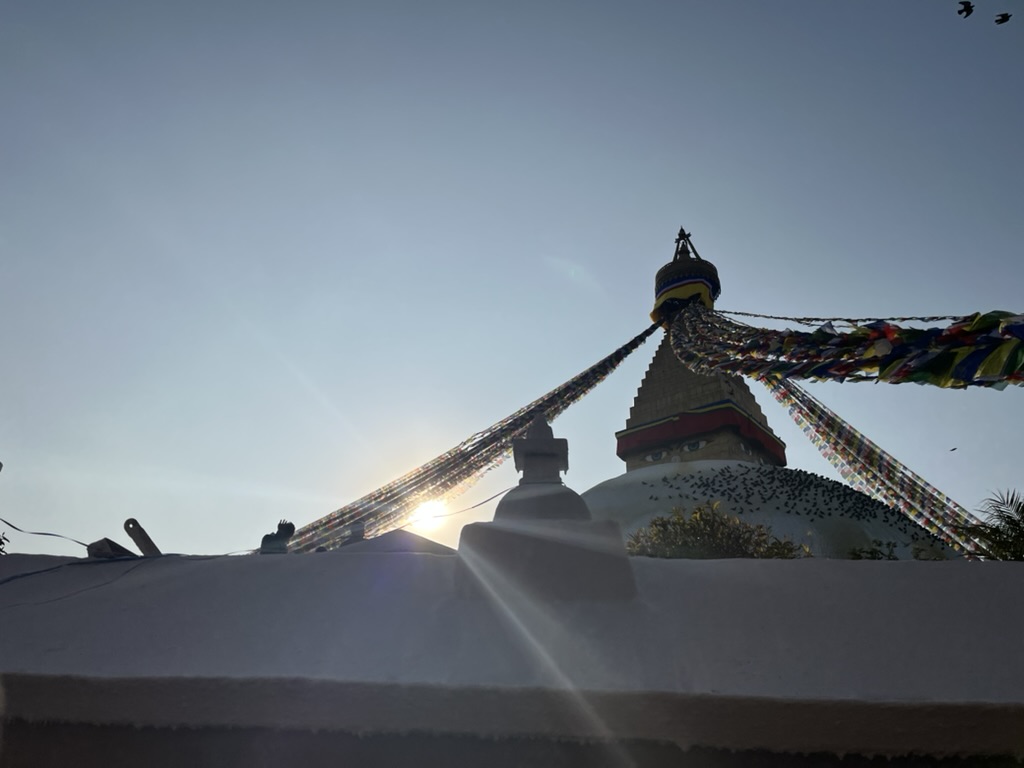
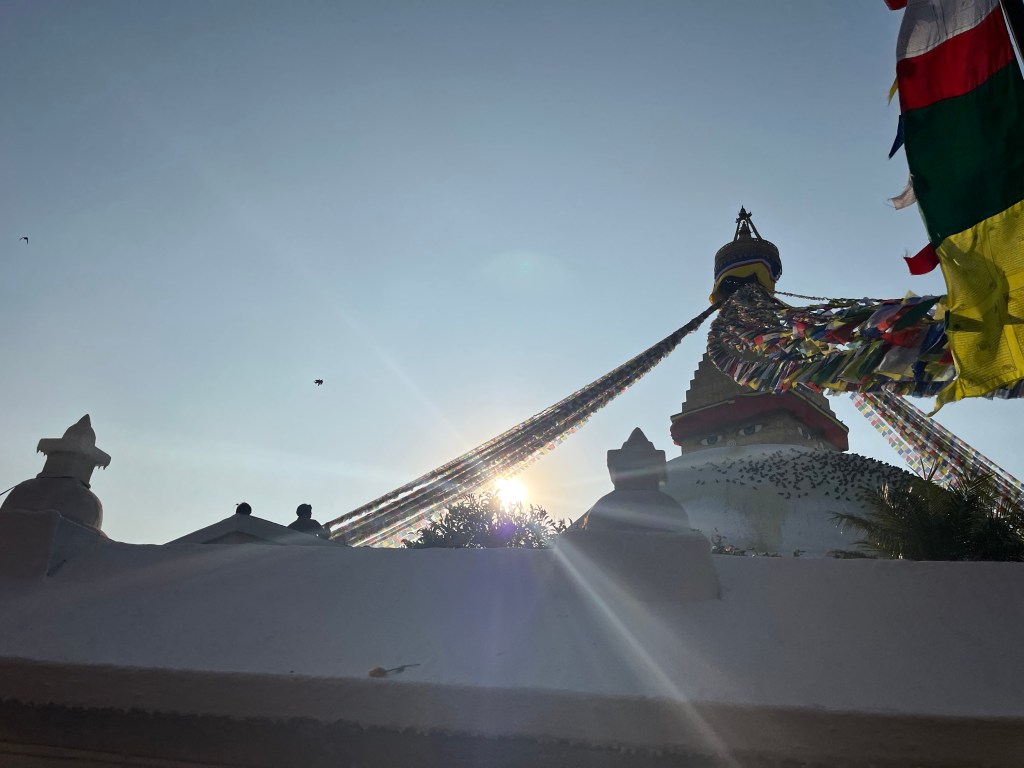
And then, through a narrow opening between crooked buildings, I saw it—the dome of Boudhanath Stupa rising against the sky, crowned with those ancient, painted eyes. My heart gave a small leap, and I whispered to myself, “Oh, that’s perfect.” It wasn’t something I thought about; it just came out, spontaneous and true. The afternoon light glowed golden on the white dome, and the eyes—steady, calm, and ancient—gazed down as if they could see everything.
I walked faster, drawn into its orbit, and soon I was swept into the kora—the clockwise circumambulation around the stupa. It’s difficult to explain how it felt. You don’t decide to walk; you simply become part of the movement. Everyone walks in the same direction—monks in maroon robes, elderly Tibetan women spinning prayer wheels, families with small children, and scattered tourists. There weren’t many Westerners—fewer than I expected, actually—but I liked it that way. There was something freeing about feeling anonymous, blending quietly into the kora, becoming part of its unbroken rhythm.
With each step, my mind grew quieter. The prayers murmured by the people around me, the spinning of prayer wheels, and the fluttering of countless prayer flags—all of it felt deeply familiar, even though I was experiencing it for the first time. It wasn’t just walking; it felt like becoming part of the mindstream of the stupa itself—a stream of prayers, aspirations, and devotion that has been flowing here for centuries. After the second or third round, the movement felt completely natural, as if I had always been there, circling under the gaze of those steady eyes.
Later, I stepped into the inner part of the stupa—a quieter, more intimate space. I found a still corner, leaning against a small stupa, surrounded by a few nuns, monks, and Tibetan women performing prostrations and prayers. Moving from the outer kora into this inner sanctuary felt like a natural progression, a seamless unfolding towards the heart of the stupa—both physically and symbolically. It was as though each step had drawn me closer, deeper into the essence of what this place holds.
Here, I made strong aspiration prayers, joining into the centuries of prayers and aspirations, the great intentions that have shaped and sustained this sacred place. I was profoundly moved, merging with the wisdom mind of the stupa—a vast, timeless awareness that holds everything within it.
I remember a pigeon landing near me, close enough that I could see the sharpness of its eyes. It sat still, tilting its head slightly, and it was as though it, too, was part of the same prayer, carried by the same stream of devotion and wisdom. Everything—the pigeons flying above, the one beside me, the people moving in prayer, the faint scent of incense—seemed perfectly aligned, naturally belonging to the same timeless moment. It was almost as if the pigeon knew, in some quiet, unspoken way, what was happening. Nothing felt separate; everything was held within the wisdom mind of the stupa, seamless and complete.
The next morning, I began my day in a small public park—Buddha Park, I think it’s called. There’s a statue of Guru Rinpoche there, standing quietly amidst the greenery. I offered incense at a communal incense burner and began my prayers. It wasn’t casual or self-conscious, but it felt almost like a coming-out—praying openly in a public space.
Around me, elderly Tibetans walked slowly, spinning prayer wheels and murmuring mantras. Some people glanced at me, curious but kind, while others simply carried on with their routines, lost in their own quiet rhythm. There was something beautiful about being there, about sharing that space—not in conversation, but in intention. The early sunlight poured over the statue, and the incense smoke curled gently into the air.
On my way to the stupa after leaving the park, I bought a small bunch of flowers to offer. Still slightly foggy from sleep and travel, I nearly tripped over something small. A boy, barely three or four years old, stood in front of me.
What struck me most was his confidence. He looked up at me with clear, steady eyes—completely unafraid, completely grounded. He knew exactly what he wanted. His face, his clothes—everything about him seemed to have stepped straight out of Tibet. He pointed at the flowers in my hand, and after a moment, I understood—he wanted one.
I handed him a small bunch, and he accepted them with a quiet, knowing smile. To my left, his parents stood watching, dressed in traditional Tibetan clothes that looked timeless, almost ancient. Their faces were warm and kind, their expressions soft with approval. The moment was brief, but it opened my heart a little more, just before I stepped once again into the steady flow of the kora.
Later, I met a friend at the inner part of the stupa. What followed was an incredible day—spontaneous, profound, and deeply meaningful. We spent time practicing together, and he showed me around. But this part of the day belongs more to the inner journey, and I’ll leave it there.
Walking around Boudhanath Stupa isn’t just walking. It’s joining something ancient, something vast. A river of prayer and aspiration that has flowed here for centuries. You don’t need to fully understand it. You just walk. You join. And in doing so, you become part of it.
For now, that’s enough. Tomorrow will bring more walks, more moments, and more encounters. And though this place is undeniably foreign, I already feel—somehow—at home.
There’s something strangely intimate about airplane conversations. Suspended thousands of feet above the earth, sealed inside a metal tube hurtling across the sky, time seems to loosen its grip. Perhaps it’s the shared vulnerability of being neither here nor there, or the fleeting certainty that these exchanges exist in a pocket outside the demands of daily life. Whatever it is, I’ve noticed it happens often to me. Almost every time I travel by plane, I end up in conversation with someone remarkable. But perhaps it’s not that I’m unusually lucky—maybe it’s that everyone becomes remarkable when you really listen.
On this flight from Amsterdam to Istanbul, I find myself next to a sturdy, tall man with Asian features. There’s something about the openness in his eyes—clear, curious, and unguarded. Before long, we’re talking.
“Short transfer in Istanbul as well?” I ask.
He smiles, and the conversation begins.
When I mention that I’m on my way to Kathmandu, he raises an eyebrow and smirks. “Ah, so you’re one of those hippies? Going to smoke hashish in the mountains?”
I laugh. “Well, do I look like a hippie who smokes hashish? I mean, I do have long hair.”
He chuckles, and I let the humor linger. It’s a light moment, one I don’t feel the need to explain. The truth is, my hair isn’t about style or rebellion—it’s part of my yogic tradition. But honestly, it doesn’t matter much to me what people think.
When I tell him I’m not traveling for leisure, but for a Buddhist pilgrimage, I see his curiosity sharpen. His posture shifts slightly, and the chatter of the cabin seems to recede as we lean into a conversation that feels less like small talk and more like discovery.
I learn that he’s Uyghur. He came to the Netherlands years ago as a refugee, spent two years in a refugee center, and eventually became a Dutch citizen. He’s lived in the Netherlands for a long time now, long enough to understand Dutch culture—not just its surface politeness, but the deeper rhythms of its modern life.
He shares openly about his experiences—his search for meaning, his frustrations with modernity, and the sense of emptiness that followed years of living a lifestyle shaped by Western ideals. He speaks candidly about things he struggled with: dating culture, fleeting connections, the party life that promised so much excitement but delivered so little satisfaction.
Screens, apps, and endless options—all of it created the illusion of abundance, but left him feeling isolated and unfulfilled. Over time, he realized there had to be more to life than what the modern world was offering.
In response, he returned to Islam. It wasn’t a dramatic moment of revelation, but a gradual return—an anchoring into something older, something solid. He speaks about his faith with warmth and clarity, and there’s a quiet strength in the way he carries it.
But beneath his calm and steady demeanor, there’s also pain—a deep, unspoken hurt that surfaces briefly when he shares a more personal story. His mother was in a re-education camp for two years. He doesn’t say much about it, but the weight of it hangs in the air between us. There’s a fragility in his voice when he mentions it, and I can see the trauma in his eyes, even if he doesn’t put it into words.
I don’t push further. Some silences are better left undisturbed, some pain too raw to probe. Instead, I listen, offering space for whatever he feels comfortable sharing.
When our conversation drifts to Buddhism, he already knows that it doesn’t involve a creator deity. But when he asks how Buddhists understand the source of everything, I feel myself treading carefully.
“What many faiths might call God,” I begin slowly, “we’d call Buddha Nature or True Nature. It’s not an external being or a creator overseeing the universe. It’s… the essence of everything. The ground of being itself.”
He listens, his brow furrowed slightly in thought.
“But at the end of the day,” I continue, “mind is at the heart of it all. In Buddhism, everything—every experience, every appearance—depends on the mind. The world we see, the suffering we feel, the peace we might find… it all comes back to the mind.”
I can sense the conversation reaching a threshold. The nuances of these concepts are difficult to express, especially to someone whose worldview is shaped by an Abrahamic perspective. It’s like trying to explain color to someone who’s only seen shades of gray—not because they lack understanding, but because the frameworks are fundamentally different.
Yet, we find common ground again when we speak of Sufi mysticism—of Rumi and Hafiz. There’s admiration in his voice, but also caution.
“It’s beautiful,” he says softly, “but also… dangerous.”
I tread carefully here. I don’t push, don’t press. Instead, the conversation lingers in that space between admiration and caution, remaining open, respectful, human.
Throughout our exchange, I notice something about him—an unspoken dignity, a quiet directness. There’s a clarity to him, a grounded confidence in how he carries his faith and his values. It’s a quality I’ve noticed before in Tibetans I’ve met—a kind of warrior-like presence, not in aggression, but in steadfastness. A quality that combines deep humility with an unshakable sense of purpose.
It’s inspiring. And it reminds me that we, as Western Buddhists, have something to learn here. Too often, Buddhism is perceived as abstract, overly philosophical, or detached. But that’s not the Buddhism I know. Guru Rinpoche embodies this perfectly—a figure of unwavering clarity, directness, and confidence.
We, too, need to exude that confidence. Not in a way that’s aggressive or rigid, but in a way that carries the weight of conviction—lived, embodied, and unshakable.
The hours pass unnoticed as we speak—nearly the entire three-and-a-half-hour flight. Faith, life, culture, politics, the emptiness of modernity, and the search for meaning—we cover everything, flowing seamlessly from one topic to the next.
As I walk through the sprawling airport, softly reciting mantras under my breath, I feel a deep sense of lightness—almost floating, yet firmly rooted.
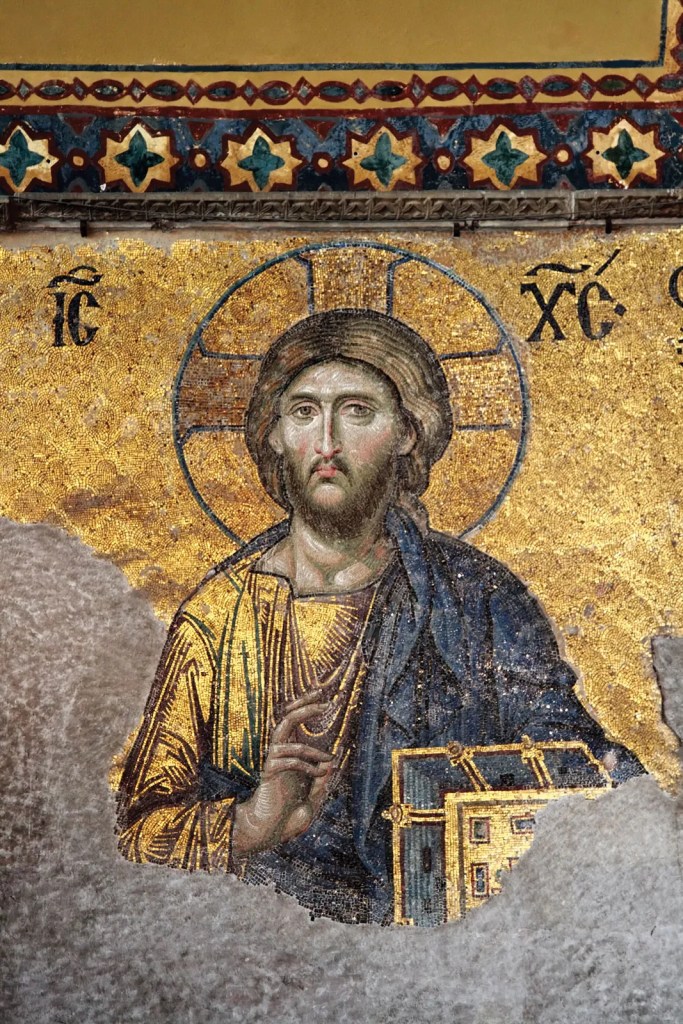
Istanbul—Constantinople, as I still sometimes call it—is a place steeped in history, where East and West have always met.
This encounter feels like the perfect beginning to my journey. A reminder of why I travel—to broaden my horizons, to meet people who challenge and inspire me, and to carry their stories with me.
The path ahead feels alive with possibility. My heart feels open, my steps feel light, and a faint smile lingers on my lips as I walk towards my gate, mantras humming softly in my mind.
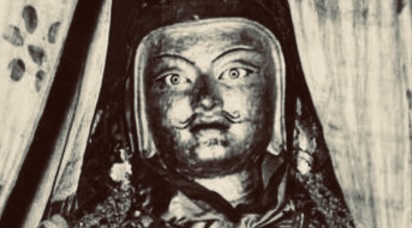
When I heard his name for the first time, it struck me—sharp, electric, like magnetic lightning through my chest. I had seen his face before, in The Tibetan Book of Living and Dying. I remember being transfixed by the stillness, the piercing gaze, the quiet power held in that image. But when my teacher spoke his name—Guru Rinpoche—it wasn’t just sound; it was force. It moved through me, unlocked something vast and impossibly familiar. It felt like something I had always known, yet it was the first time I had heard his name spoken.
From that moment on, something stayed with me. Guru Rinpoche was no longer just an image or a name in a book—he became a question, a pull, a mystery I couldn’t turn away from. I wanted to understand who he was.
That question stayed with me, quietly shaping my path, guiding me to books, teachers, situations and encounters. It wasn’t always clear, but it was always there—a thread running through my life, drawing me closer to something I couldn’t fully name but deeply recognized.
Now, as I prepare to visit the places where Guru Rinpoche meditated and taught, I feel that same pull, that same thread, that same presence leading me.
It was only later that I came to understand more about who my first teacher who introduced me to Guru Rinpoche truly was. He was recognized as a tertön, a treasure revealer, and an incarnation of Nanam Dorje Dudjom—one of Guru Rinpoche’s closest disciples. It was Nanam Dorje Dudjom, together with others sent by King Trisong Detsen, who stood at the border, welcoming Guru Rinpoche as he crossed from Nepal into Tibet, carrying the blessings that would establish Buddhism in the Land of Snow.
In earlier lives, Nanam Dorje Dudjom is said to have been one of the brothers who helped construct the Boudhanath Stupa, a monument of immeasurable spiritual significance. Those who participated in its creation are said to have been reborn as key figures in the spread of the Dharma in Tibet.
Jigme Phuntsok Rinpoche, also recognized as an incarnation of Nanam Dorje Dudjom, once wrote about the Boudhanath Stupa:
‘This stupa is not merely a structure; it is a mandala of awakened wisdom, a gateway to blessings beyond measure.’
These threads—spanning lifetimes, sacred sites, and spiritual teachings—are pulling me forward now, drawing me towards this journey. As I prepare to visit Nepal, to circumambulate the Boudhanath Stupa, and to offer prayers at the caves where Guru Rinpoche practiced, I feel immense gratitude for this opportunity.
True peace, lasting liberation, is found within the mind. That’s the essence of the Buddhist path. Yet the mind is easily swayed, distracted, and obscured. Sacred places act as powerful supports—they sharpen intention, still the mind, and most importantly, They are a support in helping to create merit or positive energy. Without merit, even the clearest teachings cannot take root, Even the simplest of intentions cannot be manifested into reality
Nepal holds some of those powerful places of support. Sacred sites where Guru Rinpoche meditated, where his realization left an imprint on stone and earth, where prayers have been carried into the wind and lifted by the smoke of sang offerings for centuries. At the Boudhanath Stupa, under its watchful ancient gaze, prayers rise—for healing, for clarity, for the true happiness of enlightenment, for the ultimate liberation of all sentient beings.
These sacred places are not separate from the mind. They are reflections of it. The mountains, the caves, the stupas—they remind us of boundless compassion and the wisdom that sees the true nature of reality, and unshakable courage already present within, waiting to be uncovered.
What might seem like ordinary stone and earth to some, for those who look deeper, shimmers with blessings—imbued with centuries of aspirations and prayers, offered by great masters and countless humble practitioners, many whose names we’ll never know. These places are not just remnants of the past; they are living mandalas, vibrant and alive, rich with presence, and luminous with the blessings of the Lotus-Born Guru.
And so, I follow these ancient threads—threads of prayer, devotion, and realization—into the heart of Nepal, stepping onto the physical ground where countless others have prayed before, carrying the quiet hope that these blessings may ripple outward, touching hearts and lives far beyond my own.
I hardly have the patience for long books anymore. It’s been like this for quite some time. When I read, it’s often short novels, poetry, or the contemplative writings of Tibetan masters, early Christian mystics, or other contemplative thinkers. Sometimes, I pick up a book and simply open it—without much thought or plan.
I’ve always had a deep love for Russian literature—for its beauty, its depth, and the way it doesn’t shy away from the rawness of the human experience.
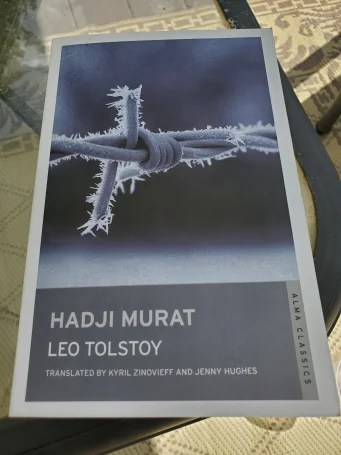
It was this Christmas evening, almost intuitively, that I picked up Hadji Murat by Tolstoy.
It wasn’t a grand decision—no carefully planned moment with tea steaming beside me or a candle flickering nearby. I just opened the book in the quiet of the evening and began to read. Sometimes, the most profound encounters come uninvited, slipping into our lives quietly, without ceremony.
It was late in the book, during a passage where Hadji Murat finds himself alone at night, surrounded by silence and the sharp glitter of distant stars. There, in that stillness, Tolstoy sketches a moment that felt eternal. Hadji Murat is neither hero nor villain—he is simply a man, caught between allegiances, between power and powerlessness, between the raw desire to survive and the unyielding dignity he carries within him.
Tolstoy doesn’t romanticize this moment. There are no grand speeches, no overt metaphors. Instead, there’s just the cold night, the heaviness of fate pressing down on a solitary figure, and the quiet clarity that suffering often brings.
“He knew that death was near, but it did not frighten him. He was only sad that all he had done and all he had lived for would end so senselessly and so soon.”
I read those lines slowly, letting the words seep into me. When I closed the book, I felt something heavy pressing on me. I needed to move. I needed some air.
So I stepped outside into the Dutch winter evening. The sky hung heavy above me—gray, clouded, low enough to feel like it might press down onto the earth. The streetlights cast long, tired shadows, and a damp, sharp, and unmistakable cold clung to the air—unique to Dutch winters.
It felt as though Hadji Murat had stepped out of the pages of the book and walked with me through the cold. His story stayed with me, lingering in my thoughts as I walked.
In Russian literature, suffering is never avoided or explained away—it’s faced directly, carried with a kind of unflinching honesty. This reflects something essential about the Russian spirit itself.
There’s a depth in it, a devotion, a fullness that holds both strength and sorrow. It’s a spirit shaped by vast landscapes, by long winters, by a history marked by suffering and resilience.
You see it in Tolstoy, in Dostoevsky, in Turgenev. There’s a willingness to confront the darkness of the human condition without turning away, but also a quiet spirituality that threads through it all. It’s a spirit that seems to live in paradox: the transcendent and the destructive, the spiritual and the brutal, devotion and despair.
It’s as if the Russian soul holds both the cathedral and the ruin within itself—something grand and sacred standing alongside something broken and tragic. You feel it in their literature, their music, and their way of confronting life.
My grandfather, who had been part of the humanitarian resistance during the Second World War, once told me, “The only good thing about those times was that it was clear who the good guys were and who the bad guys were. But after the war, I never felt that clarity again.”
His words stayed with me. Is it clear now? How do we know if we are on the right side of history?
The story of Hadji Murat—a man caught between forces far beyond his control—felt painfully familiar in the context of what’s happening there now. Ukraine has become a chessboard where global powers act out their ambitions. On one side, NATO expansion and Western geopolitical interests; on the other, Russia’s drive to secure its geopolitical influence and protect its strategic boundaries.
But those who suffer most are not sitting in offices or war rooms. They are not the policymakers or the generals studying maps. They are the people on the ground—the families huddling in basements, the elderly trapped in freezing homes, the soldiers sent to the frontlines with little choice and even less hope. They are the children who wake to the sound of explosions and the mothers who cannot promise them safety.
War is not fought by those who declare it. It’s fought by those who cannot escape it.
The stories we hear—through headlines, through broadcasts, through carefully framed talking points—reduce this suffering to something distant, something abstract. Narratives are crafted to make sense of chaos, to assign blame, to justify actions. And in this simplification, something essential is lost: the human reality of war.
In recent years, the Western media has often shaped a singular narrative—a story not just meant to inform, but to guide emotions, to align perspectives, and to secure consent. It’s how societies are prepared for conflict. It’s how fear and moral certainty become tools.
But reality isn’t a neat story. Reality is chaotic, messy, and stubborn. It refuses to fit into the categories we try to impose on it.
And when the political winds shift, these same narratives start to crack. The certainty begins to fade. The moral clarity becomes murky. And the stories we believed start to feel thin, incomplete.
For us Europeans, it’s easy to let ourselves be swept into geopolitical currents shaped by distant powers—primarily American geopolitical interests. But we shouldn’t allow ourselves to be played apart from Russia. Geographically, historically, and spiritually, we are not so far from each other as we might like to believe.
At that moment, I turned a corner and saw a Christmas tree glowing softly in the window of a nearby house. The warm golden lights reflected gently off the glass, and a quiet stillness seemed to settle around me.
It reminded me how much we still share—this Christian legacy that shaped both Russia and the West, and this deeper humanity expressed through it. Despite our differences, despite the divisions, there are still fragile threads that connect us—threads woven from wisdom, from ancient traditions, from the teachings of saints and contemplatives, from the simple truths of our humanity.
These threads are fragile, yet they endure. They remind us that societies are not abstract entities—they are made of countless individual decisions. Every choice we make, every word we speak, every moment we act with compassion or give in to fear, contributes to the collective direction we take.
In the stillness of the night, under heavy skies and scattered lights, I thought of the words of Buddhist teachers—that the roots of war and peace lie not in nations or treaties, but in our minds. As the Dhammapada says: “The mind is everything. What you think, you become.” And “The mind is the forerunner of all things.”
If we want to change the world, we must start by changing our minds. From clarity and stillness within, peace begins to flow outward—into our words, our actions, and the way we meet others.
May we find the courage to keep our hearts open despite the vast and unyielding suffering of our world.
Growing up in the Netherlands in the 1990s, I always felt something was missing. There was no framework to understand or experience beauty meaning or a deeper transcendent reality, no connection really to anything sacred. Secularism had taken over, and while it brought certain freedoms, it also left a cultural void. Materialism basically dominated, reducing life to what could be measured or owned, leaving little room for reverence or awe. Even Christianity, in the form I encountered in my youth, often felt hollow—stripped of mystery, ritual, and beauty. And yet, this wasn’t just my personal experience. It reflects something much larger: a spiritual crisis in the West.
At times, I caught glimpses of something deeper. I remember my grandparents. They were of a generation that still carried a sense of dignity, even in simple things. The way they cared for their home, the atmosphere they created, it was subtle but palpable. There was a respect for life, a quiet humility, and a sense of meaning that was woven into the everyday.
Before meals, they would pause to say a prayer “Our Father, who art in heaven…” their voices steady, their words spoken with sincerity. Sundays were treated as a special day, marked by stillness and simplicity. Life seemed to slow down in their home as if the day itself was set apart for something sacred. These small rituals reflected a connection to something larger, something that gave their lives a quiet depth and order. It was a reminder of older values, of something we’ve largely lost in the modern West.
The Spiritual Desert of the West
Today, the West has become a spiritual desert. Materialism has flattened our view of the world, reducing human beings to biological machines and dismissing anything that cannot be quantified. Beauty, dignity, and the sacred have been pushed to the margins. As Ian McGilchrist writes in The Master and His Emissary: “We have created a world that is paradoxically everywhere and nowhere, increasingly virtual, and increasingly lacking in depth and meaning.” This lack of depth manifests in every area of life, leaving people disconnected from themselves, from each other, and from the world.
This crisis didn’t arise in isolation. Materialism is not some separate force that swept in and replaced religion it’s the result of the West’s own historical and cultural development. Protestantism, for all its virtues, rejected mystery and beauty in favor of rationality and utility. Over time, this mindset paved the way for modern capitalism and the materialistic worldview we see today. Tom Holland captures this well in his book Dominion, tracing how Christianity shaped the West’s values, but also how these values evolved into something disconnected from the sacred. We’ve lost our way, not by abandoning our roots, but by distorting them.
Our modern-day practice of spirituality hasn’t escaped this distortion. Western Buddhism, for instance, is often reduced to merely a tool for self-improvement, or through frameworks shaped by materialism or even Christian moralism. These are not words of reproach, but reflections born of my own experience with these difficulties. Through the years, I’ve come to understand, often through my own missteps that its vital to fully embrace a transcendent sacred worldview.
Buddhism is not a self-help tool, a utility, or a hobby. It’s about a radical shift in perspective, a letting go of dualistic thinking, and stepping into something far greater than ourselves.
Western Buddhists and the Struggle to Go Beyond
One of the most difficult things about being a Buddhist in the West is recognizing the water we swim in. Materialism and Christian frameworks are so deeply embedded in Western culture that we often don’t even see them. I’ve experienced this in myself, and I’ve seen it in others. Even as I embraced Buddhism, I found myself holding onto materialistic ways of thinking, viewing practice as something utilitarian, something to “fix” or improve myself. I also unconsciously carried Christian-influenced ideas of morality, seeing things in terms of right and wrong, or good and bad, rather than the more subtle and nuanced view Buddhism offers.
I’ve noticed this even more strongly in the generation that came before me, particularly among baby boomers. Many of them rebelled strongly against Christianity, rejecting its traditions and dogmas. But in doing so, they often failed to see how deeply shaped they still were by the Christian worldview. It’s as if they wanted to start fresh but couldn’t recognize the water they were still swimming in. The same is true of materialism, which permeates so much of the Western mind. Even long-term practitioners (myself included, admittedly) often unconsciously approach Buddhism through these lenses, unable to go beyond.
These influences are subtle and pervasive, and it takes tremendous effort to go beyond them. Buddhism offers us a path to transcend both nihilism (the materialist view that nothing has meaning) and eternalism (the Christian-like belief in a fixed, ultimate reality). But stepping into this path requires us to question everything we’ve been conditioned to think and believe. It requires courage, not just to reject old frameworks, but to let go of them entirely.
Dignity and the Sacred
For me, at the heart of this transformation is a rediscovery of dignity. And by dignity, I don’t mean the superficial kind tied to status or comfort. I mean the dignity that comes from recognizing our own basic goodness, what Trungpa Rinpoche called the intrinsic worth we all possess simply by existing. This understanding of dignity contrasts sharply with the modern Western worldview, where worth is measured by what you produce or own. It’s even there in the term net-worth.
I’ve been privileged to meet Buddhist masters who embody this innate dignity completely. Some of them had almost no possessions or social standing, yet their presence is awe-inspiring. The way they move, the way they wear their robe, the way they conduct themselves it radiates a quiet, yet profound self-respect and humility a dignity that isn’t dependent on external validation. It comes from within.
But dignity isn’t just personal. It reflects outward, shaping how we treat others and how they, in turn, treat us. When I began to live with more self-discipline, self-love, respect for my own Buddha nature, I noticed something profound: others naturally began to treat me with more respect, too. This is a small example, and it points to something larger. Dignity isn’t just about the individual it’s the foundation of meaningful relationships and communities and a sane society
Vajrayana and the Magic of Guru Rinpoche
What I’ve come to realize is that embracing the sacred worldview of Buddhism isn’t just about adopting new ideas. It’s about undoing the karmic frameworks/habits from our past and present lives
This is why I find Vajrayana Buddhism so profoundly transformative. It’s a tradition that doesn’t just speak to the mind only, it engages the body, speech, and mind as inherently sacred. Vajrayana practices aren’t abstract, they are vivid, embodied, and alive. They remind you, in every movement and word, that you are already an expression of Buddha nature.
And then there are the stories, especially the extraordinary life of Guru Rinpoche. Guru Rinpoche isn’t just a figure from the past—he’s a living presence in the Vajrayana tradition, a practice, and a teaching all at once. His stories are filled with magic, mystery, and an energy that defies all logic. They show us a world that is far richer and more layered than the one materialism presents to us. These stories aren’t meant to be rationalized, they are meant to open your heart and mind to a sacred reality that transcends conventional thinking.
Guru Rinpoche represents the perfect union of wisdom and skillful means. A master embodying the sacred in every action, every word, every thought. His life and teachings challenge everything we’ve been conditioned to believe in, especially in the West. They invite us to step into a reality where the sacred is everywhere, where nothing is mundane, and where every aspect of life is alive with meaning.
A humble reflection
Writing these reflections has been a way for me to gather my thoughts on what feels essential: dignity, beauty, and the sacred. These are not luxuries. They are the foundation of what makes makes us human and what makes live meaningful. And yet they seem to be slipping further away in the modern world. I’ve seen this loss in myself, in the culture I grew up in, and even in the ways we sometimes approach spirituality.
For me, the journey toward rediscovering these qualities has been shaped by the teachings of the great masters I’ve been fortunate to meet, and by the example of simple lives lived with dignity and care, like my grandparents. Their quiet humility and sense of meaning, rooted in something beyond themselves, have stayed with me as a reminder of what we’ve largely lost, but what we can find again.







 Steps into stillness