

Time feels different here. I’ve only been in Kathmandu for two days, yet it feels like I’ve been here much longer. The city moves with a rhythm that’s both fast and unhurried, chaotic yet seamless. Even the tangled flow of traffic—cars, motorbikes, and pedestrians weaving through narrow streets—feels strangely calm, as if everyone is following an invisible choreography.

At the airport, one of the first things I noticed was a sign: “Welcome to Nepal, the birthplace of the Buddha.” It was quite cool to see that right there, stepping off the plane. Inside the terminal, statues of the Buddha were built into the walls—small sanctuaries tucked between the noise and movement of travelers. It felt like a quiet reminder that even here, amidst luggage belts and arrival halls, something sacred was already present.
The taxi ride to my guest house was smooth, and the driver was both kind and patient—qualities I would notice again and again in the people here. I’m staying at Sechen Guest House, attached to a monastery. My room is simple and carries a quiet, undisturbed stillness. But despite the fatigue from travel and a mind still foggy from lack of sleep, I didn’t take time to settle in. The stupa was calling, and I couldn’t wait.

The walk to Boudhanath Stupa was short—barely ten minutes—but the narrow streets twisted into a chaotic maze. I was still feeling spaced out from jet lag, and I took photographs of the turns as I walked, not out of curiosity, but because I was afraid I’d get lost on my way back. Without an internet connection, the photos were my breadcrumbs. But even in that disoriented state, I felt pulled forward by something steady and certain.

And then, through a narrow opening between crooked buildings, I saw it—the dome of Boudhanath Stupa rising against the sky, crowned with those ancient, painted eyes. My heart gave a small leap, and I whispered to myself, “Oh, that’s perfect.” It wasn’t something I thought about; it just came out, spontaneous and true. The afternoon light glowed golden on the white dome, and the eyes—steady, calm, and ancient—gazed down as if they could see everything.
I walked faster, drawn into its orbit, and soon I was swept into the kora—the clockwise circumambulation around the stupa. It’s difficult to explain how it felt. You don’t decide to walk; you simply become part of the movement. Everyone walks in the same direction—monks in maroon robes, elderly Tibetan women spinning prayer wheels, families with small children, and scattered tourists. There weren’t many Westerners—fewer than I expected, actually—but I liked it that way. There was something freeing about feeling anonymous, blending quietly into the kora, becoming part of its unbroken rhythm.
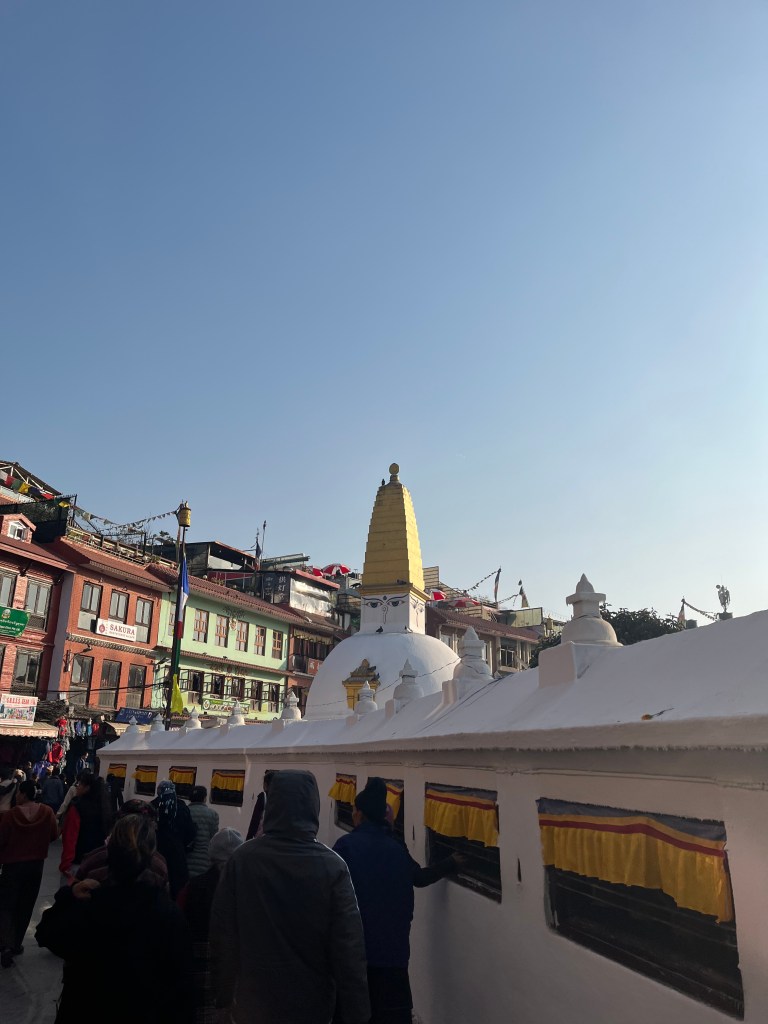
With each step, my mind grew quieter. The prayers murmured by the people around me, the spinning of prayer wheels, and the fluttering of countless prayer flags—all of it felt deeply familiar, even though I was experiencing it for the first time. It wasn’t just walking; it felt like becoming part of the mindstream of the stupa itself—a stream of prayers, aspirations, and devotion that has been flowing here for centuries. After the second or third round, the movement felt completely natural, as if I had always been there, circling under the gaze of those steady eyes.

Later, I stepped into the inner part of the stupa—a quieter, more intimate space. I found a still corner, leaning against a small stupa, surrounded by a few nuns, monks, and Tibetan women performing prostrations and prayers. Moving from the outer kora into this inner sanctuary felt like a natural progression, a seamless unfolding towards the heart of the stupa—both physically and symbolically. It was as though each step had drawn me closer, deeper into the essence of what this place holds.
Here, I made strong aspiration prayers, joining into the centuries of prayers and aspirations, the great intentions that have shaped and sustained this sacred place. I was profoundly moved, merging with the wisdom mind of the stupa—a vast, timeless awareness that holds everything within it.
I remember a pigeon landing near me, close enough that I could see the sharpness of its eyes. It sat still, tilting its head slightly, and it was as though it, too, was part of the same prayer, carried by the same stream of devotion and wisdom. Everything—the pigeons flying above, the one beside me, the people moving in prayer, the faint scent of incense—seemed perfectly aligned, naturally belonging to the same timeless moment. It was almost as if the pigeon knew, in some quiet, unspoken way, what was happening. Nothing felt separate; everything was held within the wisdom mind of the stupa, seamless and complete.
The next morning, I began my day in a small public park—Buddha Park, I think it’s called. There’s a statue of Guru Rinpoche there, standing quietly amidst the greenery. I offered incense at a communal incense burner and began my prayers. It wasn’t casual or self-conscious, but it felt almost like a coming-out—praying openly in a public space.
Around me, elderly Tibetans walked slowly, spinning prayer wheels and murmuring mantras. Some people glanced at me, curious but kind, while others simply carried on with their routines, lost in their own quiet rhythm. There was something beautiful about being there, about sharing that space—not in conversation, but in intention. The early sunlight poured over the statue, and the incense smoke curled gently into the air.
On my way to the stupa after leaving the park, I bought a small bunch of flowers to offer. Still slightly foggy from sleep and travel, I nearly tripped over something small. A boy, barely three or four years old, stood in front of me.
What struck me most was his confidence. He looked up at me with clear, steady eyes—completely unafraid, completely grounded. He knew exactly what he wanted. His face, his clothes—everything about him seemed to have stepped straight out of Tibet. He pointed at the flowers in my hand, and after a moment, I understood—he wanted one.
I handed him a small bunch, and he accepted them with a quiet, knowing smile. To my left, his parents stood watching, dressed in traditional Tibetan clothes that looked timeless, almost ancient. Their faces were warm and kind, their expressions soft with approval. The moment was brief, but it opened my heart a little more, just before I stepped once again into the steady flow of the kora.
Later, I met a friend at the inner part of the stupa. What followed was an incredible day—spontaneous, profound, and deeply meaningful. We spent time practicing together, and he showed me around. But this part of the day belongs more to the inner journey, and I’ll leave it there.
Walking around Boudhanath Stupa isn’t just walking. It’s joining something ancient, something vast. A river of prayer and aspiration that has flowed here for centuries. You don’t need to fully understand it. You just walk. You join. And in doing so, you become part of it.
For now, that’s enough. Tomorrow will bring more walks, more moments, and more encounters. And though this place is undeniably foreign, I already feel—somehow—at home.
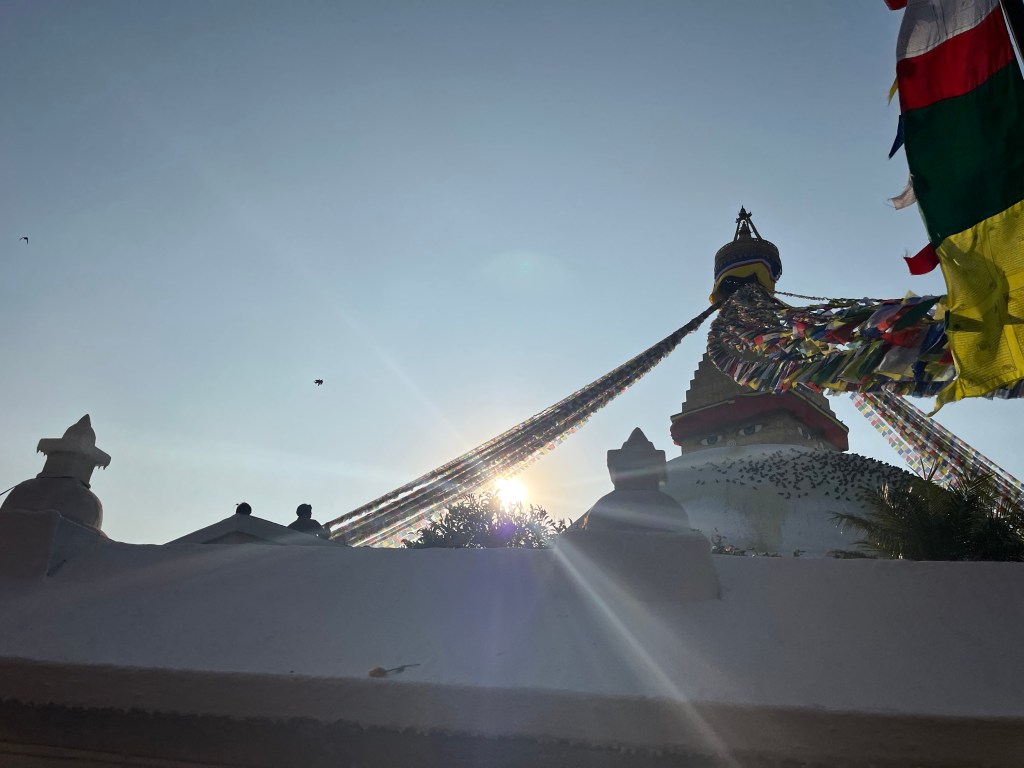
 Steps into stillness